



 76767 08888



Key Takeaways for Parents:
- 3-word sentences help kindergarten children move from recognising words to reading meaningful phrases.
- Short sentences improve reading fluency, confidence, and early comprehension skills.
- Using familiar words and repetition supports independent reading and speaking.
- Simple sentence practice strengthens early grammar, vocabulary, and communication.
- Everyday routines and playful activities make sentence learning natural and engaging.
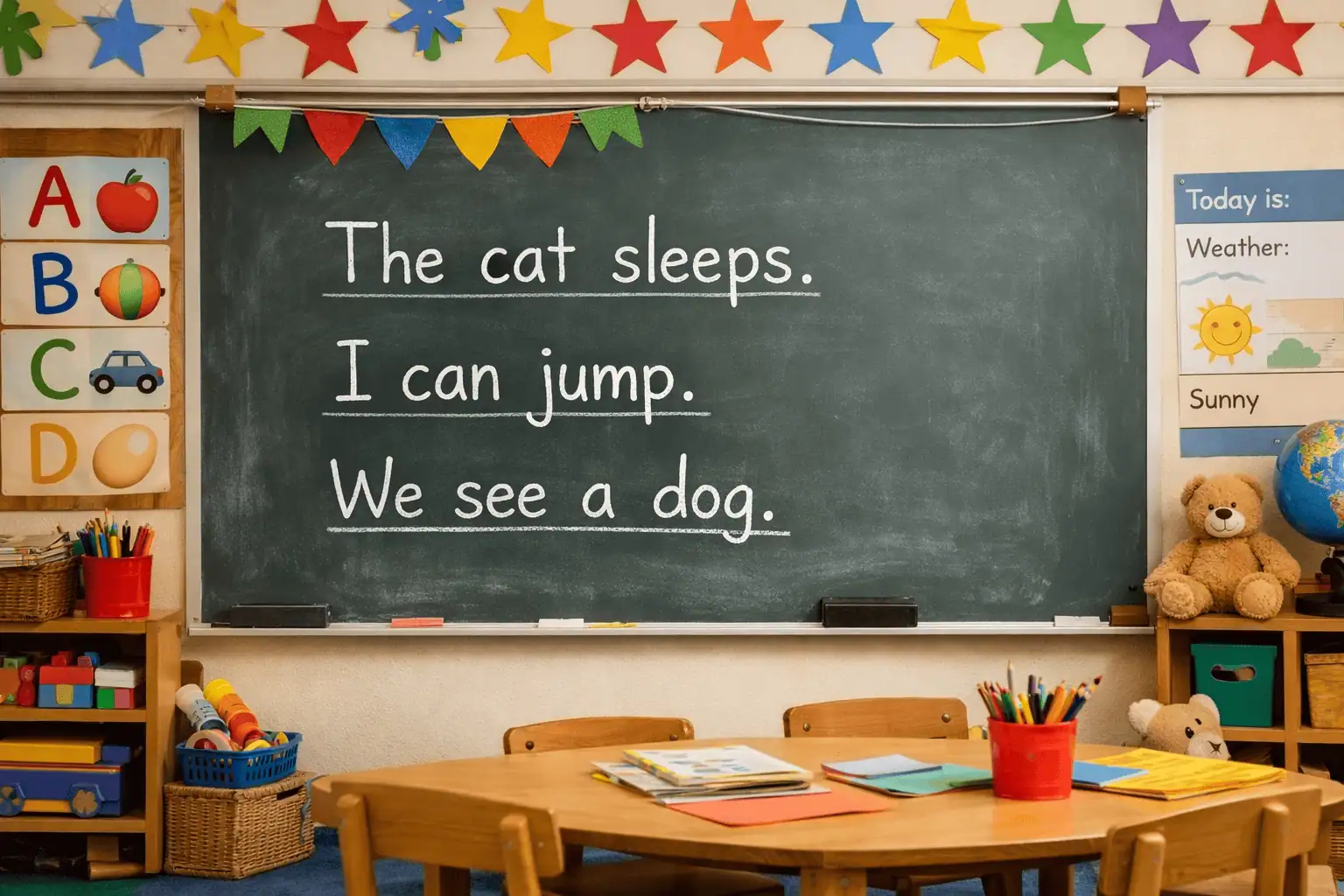
Learning to read begins with understanding how words come together to create meaning. For kindergarten children, 3-word sentences offer a simple and engaging way to practise reading, recognise familiar words, and understand basic sentence structures.
3-word sentences for kindergarten use simple vocabulary, sight words, and everyday language to help children build reading fluency, vocabulary, comprehension, and speaking confidence. With regular practice through stories, games, and playful activities, children can gradually move from recognising individual words to reading simple sentences independently.
Why Do 3-Word Sentences Matter in Early Learning?
Short sentences play a powerful role in early literacy development in children. Here’s why these matter in early learning:
-
Supports Early Reading Fluency
Because the sentence length is manageable, children can focus on reading smoothly rather than struggling to remember too many words at once. Repeated exposure to 3-word sentences helps kindergarten children improve left-to-right tracking, word recognition, and pacing. Over time, this consistency builds reading fluency.
-
Strengthens Vocabulary & Word Connections
When children practise three-word sentences, they learn how familiar words connect to create meaning. So instead of memorising isolated words, they begin to understand how words work together in context. This supports better vocabulary retention and helps children recognise that words change meaning depending on how they are used.
-
Introduces Basic Sentence Structure Naturally
Three-word sentences gently introduce children to the idea that sentences follow a structure, usually a subject, action, and object. Without formal grammar instruction, children begin to notice patterns such as “I see dog” or “We play ball.” This exposure lays the foundation for understanding sentence formation in a natural, stress-free way.
-
Builds Confidence & Independent Reading Skills
Reading short, predictable sentences allows children to experience success quickly, which boosts confidence. When children realise they can read a full sentence on their own, they are more motivated to keep practising. This sense of achievement encourages independent reading and reduces fear or resistance toward books.
-
Improves Speaking & Expression
Practising short sentences supports both reading and spoken language development. When children repeat or read 3-word sentences in English, they gain confidence in pronunciation and sentence rhythm, which helps them express ideas more clearly.
How to Teach 3-Word Sentences to Kindergarteners
Teaching sentence reading works best when learning is gradual, visual, and interactive. Here’s how to teach young learners:
-
Start With Word Recognition
Begin by introducing common sight words such as the, is, can, see, my, and it. Flashcards, picture charts, and printable worksheets help children recognise these words quickly and confidently. This stage prepares them to move from isolated words to 3-word sentences in English.
-
Move to Simple Sentence Construction
Once children recognise words, combine them into short phrases. Use picture cards and sentence strips to show how words connect.
Examples:
- Picture of a car → “I see car.”
- Picture of an apple → “The apple is red.”
This approach strengthens comprehension through visual context.
-
Practise With Reading & Reveal Games
Interactive games make sentence reading fun and memorable. Cover one word at a time and reveal it as children read along. This builds anticipation and reinforces sentence flow.
Games like these get kids to practice 3-word sentences without pressure.
-
Encourage Speaking Practice
Speaking and reading develop together. Use imitation games where adults say a sentence and children repeat it aloud together.
For example:
- Adult: “I like bananas.”
- Children repeat together.
This strengthens pronunciation, memory, and spoken confidence.
Discover our fun & easy guide to sight words that makes learning to read simple, engaging, & effective.
Start Exploring Sight Words Today!
List of 3-Word Sentences in English for Kindergarten Children
Short, familiar sentences help children practise reading in real-life contexts. Here’s a list of all the 3-word sentences you can introduce your child to based on different categories:
-
Daily Routine Sentences
- I brush teeth.
- I eat lunch.
- I go school.
- Mom makes lunch.
- Dad drives car.
- We wash hands.
- I pack bag.
- It’s snack time.
These support daily vocabulary and routine recognition.
-
Nature & Animal Sentences
- The sun shines.
- I see dog.
- The cat jumps.
- Birds can fly.
- The frog hops.
- We feed ducks.
- The rain falls.
- The tree grows.
These sentences encourage observation and curiosity.
-
Emotion & Expression Sentences
- I am happy.
- She is sad.
- We love toys.
- I like you.
- He feels brave.
- I feel kind.
- We are friends.
- They are kind.
These 3-word sentences support emotional expression and social learning.
-
Action Sentences
- I can run.
- He can jump.
- We play ball.
- I draw cat.
- She reads book.
- They sing songs.
- I build blocks.
- We open door.
Action-based sentences improve comprehension through movement.
-
Objects & Location Sentences
- The red ball.
- I have hat.
- The big box.
- She finds toy.
- I open door.
- We close book.
- He picks flower.
- The green tree.
These help children connect language to their surroundings.
-
Food & Mealtime Sentences
- I eat apples.
- She drinks milk.
- We share cookies.
- He loves pizza.
- I like cake.
- You get snack.
- We pour juice.
- They eat fruit.
These familiar phrases support comfort and routine-based learning.
Explore our list of two-letter words designed to boost early vocabulary and reading fluency in young learners.
Learn Two-Letter Words Now!
Activities to Reinforce Learning
Practising these sentences becomes more effective when children interact with them through play-based activities.
-
Build-a-Sentence Worksheets
Build-a-sentence worksheets help children understand how individual words come together to form meaningful sentences. By rearranging given words, they actively practise sentence structure, word recognition, and sequencing skills. This activity supports early grammar awareness and helps them become more confident in reading independently.
-
Cut & Paste Sentence Games
In this activity, children match pictures with the correct 3-word sentence by cutting and pasting word strips or sentence cards. This visual association helps them connect written words with real-world objects and actions.
-
Read & Reveal Board Activities
Read-and-reveal activities keep children engaged by uncovering one word at a time in a sentence. As each word is revealed, the child has to predict, read aloud, and complete the sentence together. This interactive approach improves reading fluency, attention span, and confidence.
-
Colouring & Writing Sheets
Colouring sheets paired with short sentences allow children to link reading with creativity. In this activity, the child has to colour the picture first and then trace or read the corresponding three-word sentence, reinforcing comprehension through repetition.
Tips for Parents & Teachers
Helping children understand 3-word sentences works best when parents and teachers work together. Adults need to keep the learning simple, consistent, and pressure-free. These practical tips can help:
- Start With Familiar Words: Begin with words children already hear and use in daily life, such as objects, actions, and people around them.
- Use Repetition With Purpose: Repeating the same three-word sentences across different activities helps children recognise patterns and remember sentence flow. This builds fluency.
- Support Learning With Visual Cues: Pictures, flashcards, and real objects make sentences easier to understand and remember.
- Read a Few Sentences Every Day: Short, daily practice is more effective than long, infrequent sessions. Reading two or three 3-word sentences each day keeps learning manageable and builds routine without overwhelming the child.
- Praise Effort, Not Just Accuracy: Positive feedback encourages children to keep trying, even when mistakes happen. Praising their effort builds motivation and confidence.
- Use Play-Based Digital Tools Wisely: Educational games and interactive reading tools can reinforce learning when used in moderation. These work best when they complement hands-on reading, speaking, and sentence-building activities.
Common Mistakes to Avoid
Avoiding these pitfalls ensures smoother learning for young learners:
- Introducing children to complex words too early.
- Skipping phonics before sentence reading.
- Teaching without visual support.
- Ignoring pronunciation practice.
Simple, structured learning paired with visual, hands-on activities always works best. Also, be patient and don’t rush the child. Every young one learns at their own speed, so be patient.
How KLAY Supports Early Reading Skills
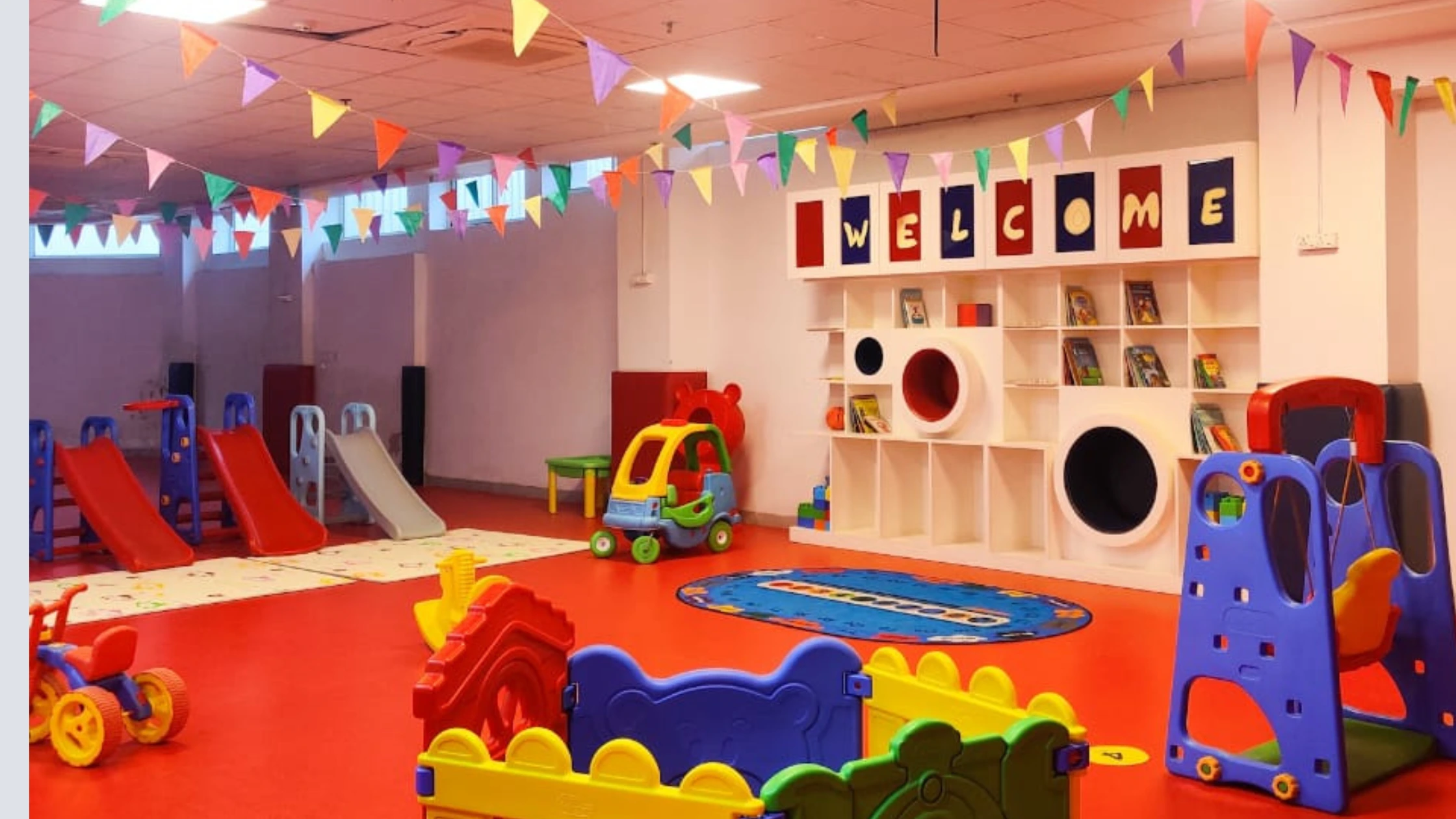
At KLAY Preschools & Daycare, children build early literacy skills through age-appropriate, engaging learning experiences. Activities such as word recognition, storytelling, phonics, sentence practice, and play-based learning help children develop vocabulary, communication, and early reading confidence. By learning through everyday experiences and interactive activities, children can gradually progress from recognising individual words to reading simple sentences independently.
Explore the Program
Conclusion
Early reading success depends on small, consistent steps. Teaching 3-word sentences helps children move from word recognition to meaningful reading with confidence. By using familiar vocabulary, engaging activities, and daily practice, children develop strong foundations in reading, speaking, and comprehension that support lifelong learning.









Subscribe to our newsletter
[contact-form-7 id="12706" title="Newsletter Form for post page"]Our Related Blogs
Yoga Benefits, Activities, and Poses for Preschoolers
For preschoolers, yoga isn’t about perfection but about giggles and benefits. So, are you curious how a simple stretch can support a child’s focus, flexibility, and emotional well-being? Let’s roll...
Year-End Reflection and Goal Setting for Children
Parenting is a journey filled with the brightest moments and valuable lessons, both for us and our children. As the year draws to a close, it’s the perfect time to...
Work-Life Balance Solutions for Parents in Emerald Hills Rd, Sector 65, Gurugram: The KLAY Daycare Advantage
Finding the perfect balance between professional commitments and parenting is a challenge for many working families in Gurugram. Parents in Emerald Hills Rd, Sector 65, especially, look for childcare solutions...