



 76767 08888




Key Takeaways
-
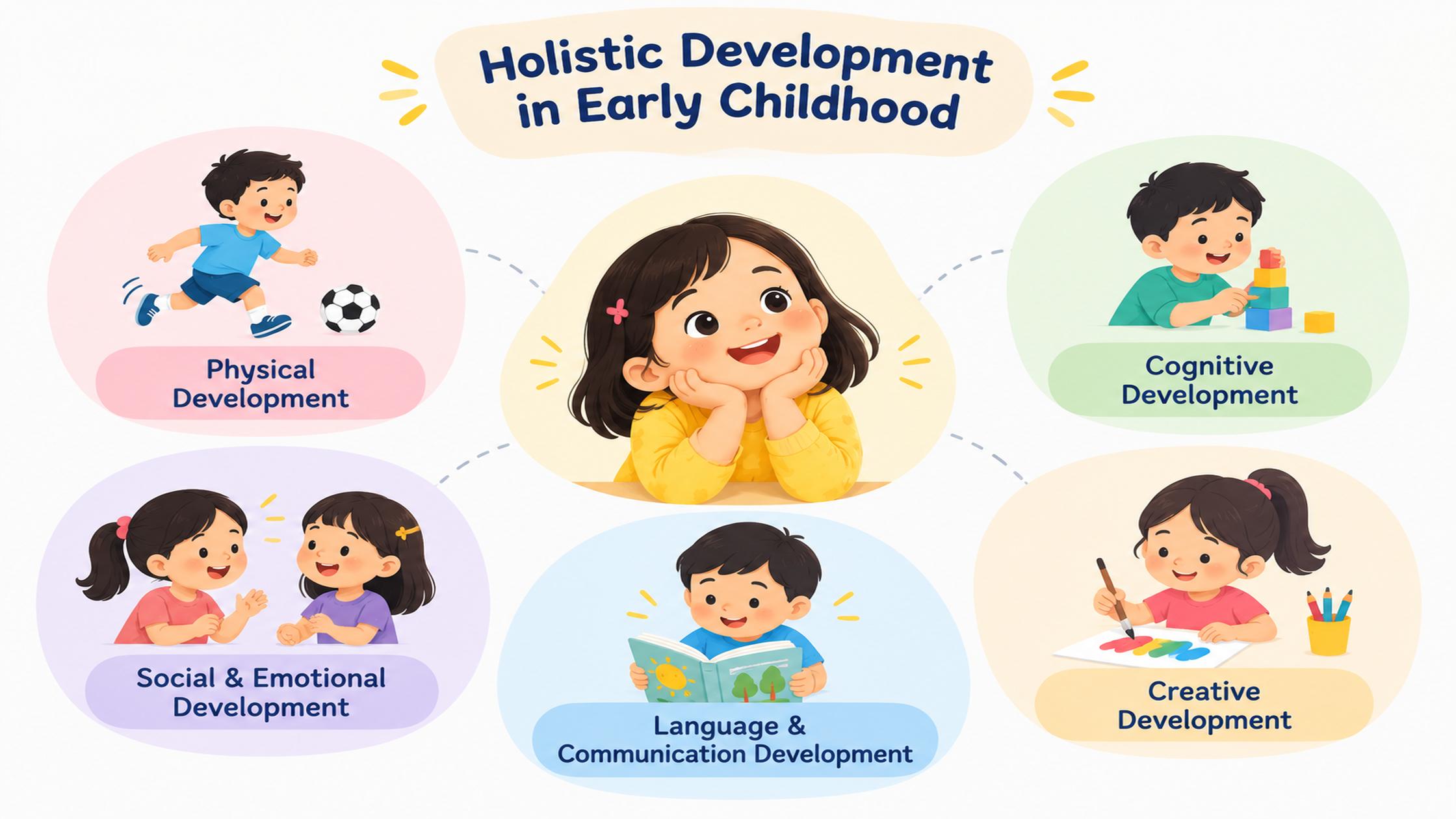
- Holistic development in preschool focuses on the whole child, including their physical, cognitive, social, emotional, language, and creative growth.
- These areas of development are connected, so children can build several skills through one meaningful activity.
- Preschools can support overall development through play, movement, conversations, creative experiences, and group interactions.
- Parents can help at home through everyday routines, play, conversations, and age-appropriate responsibilities.
The preschool years are about much more than academic learning and school readiness. Children are also learning how to move confidently, express their feelings, communicate with others, solve problems, make choices, and explore their creativity.
Holistic development in preschool means supporting a child’s growth across physical, cognitive, social, emotional, language, and creative areas. Rather than focusing only on academics, children learn through play, movement, conversations, relationships, creativity, and hands-on experiences that build skills for school and everyday life…
What Is Holistic Development in Early Childhood?
Holistic development supports the different areas of a child’s development. So, instead of treating physical, cognitive, social, emotional, language, and creative skills as separate, it recognises that they influence and support one another.
For instance, when children play in a group, they move their bodies, listen to instructions, communicate with others, manage emotions, and solve simple problems all at the same time.
5 Key Areas of Holistic Development in Preschoolers
1. Physical Development
In preschoolers, physical growth includes the development of gross motor skills and fine motor skills, coordination, movement, and independence in everyday tasks. Kids can benefit from physical activities to support larger body movements, while activities like drawing and building involve smaller hand and finger movements.
2. Cognitive Development
Cognitive development involves thinking, remembering, exploring, reasoning, and solving simple problems. Children develop these skills as they investigate their surroundings and try to understand how things work.
Cognitive activities such as puzzles, sorting objects, counting items, or conducting age-appropriate experiments can encourage them to observe, compare, and think through a problem.
3. Social & Emotional Development
This includes recognising and expressing feelings, building relationships, cooperating with others, and developing confidence.
Kids’ social-emotional skills grow through regular interactions with adults and other children. For example, group activities and role play teach them how to share, take turns, listen to others, and express different emotions.
4. Language & Communication Development
A preschooler can develop their language and communication skills by listening, speaking, building their vocabulary, and expressing their thoughts and ideas.
Storytelling, songs, conversations, and show-and-tell can encourage them to listen carefully and communicate their ideas.
5. Creative Development
For kids, this involves imagination, self-expression, exploration, and using different forms of art and movement. Drawing, music, dance, pretend play, and open-ended activities can give them the freedom to explore ideas and express themselves in different ways.
What Is the Importance of Holistic Development in Preschoolers?
Overall development matters in early childhood as it gives young children a solid foundation for learning and everyday life. A child may know how to count, for example, but also needs communication, confidence, social skills, physical coordination, and curiosity to use what they learn in meaningful situations.
This balanced approach can:
- Build a Foundation for Future Learning: Children develop skills and learning habits that can support their continued development.
- Encourage Confidence & Independence: When kids are allowed to make choices, complete tasks, and try new activities, it helps them become more confident.
- Support Relationships & Emotional Wellbeing: Children learn to recognise feelings, interact with others, cooperate, and manage everyday social situations.
- Develop Curiosity & Problem-Solving Skills: Everyday experiences encourage them to ask questions, explore possibilities, and think about different solutions.
- Support Life Skills: With a balanced learning approach in early childhood, kids learn real-life skills like communication, movement, self-care, cooperation, and decision-making.
How Do Preschools Encourage Holistic Development?
In a preschool, kids can explore different situations, interact with new people and environments, practise their skills, and learn through meaningful experiences. Here’s how it can support your child’s overall development:
1. Play-Based Learning
With play-based learning, children explore different ideas while developing different skills. For example, while playing pretend play with their peers, they learn to use their words to communicate. Their language skills evolve, and they learn to interact, make decisions, and develop their imagination.
2. Hands-On Experiences
Hands-on activities allow children to learn by doing rather than only listening or watching. Building with blocks, working with clay, sorting objects, or exploring different textures can encourage children to observe, experiment, and solve simple problems.
3. Outdoor Play
Outdoor activities and physical activities allow children to move, explore, and interact with their surroundings. A simple obstacle course, for instance, can involve movement, listening, coordination, and problem-solving.
4. Stories, Music, & Creative Activities
Stories, songs, art, dance, and pretend play support communication and creative development. For example, after listening to a story, children could draw a character or act out a scene, combining language with creativity and social interaction.
5. Group Interactions
Through group activities, kids can practise listening, communication, cooperation, and learn to wait for their turn. For example, a group storytelling activity can encourage children to listen to their peers and contribute their own ideas once they are done talking.
6. Everyday Routines & Responsibilities
Building a healthy routine for preschoolers allows them to practise independence and self-care. You can assign them simple responsibilities, such as putting away toys or organising their belongings.
How Can Parents Encourage Holistic Development at Home?
- Give Simple Responsibilities: Let them help with age-appropriate household tasks, such as putting away toys or arranging their books.
- Read & Talk Together: Read stories regularly and ask children about what they see, think, and feel.
- Move Around: Include outdoor play, walking, dancing, or other age-appropriate physical activities in their day.
- Encourage Creativity: Kids can draw, dance, build, and engage in pretend play.
- Talk About Feelings: Ask children how they felt during the day and encourage them to describe their experiences.
- Offer Simple Choices: Let children make age-appropriate decisions and encourage them to think about possible solutions when they face small problems.
Explore KLAY’s Foundational Development Programme, designed to nurture learning through play, exploration, and meaningful experiences.
FAQs:
1. What are the areas of holistic development in early childhood?
The main areas include physical, cognitive, social, emotional, language, and creative development. These are interconnected, and children can often develop skills across several areas through one activity.
2. Why is holistic development important for preschoolers?
Holistic development helps children build a broad range of skills rather than focusing only on academic learning. It can support their physical abilities, thinking skills, communication, relationships, emotional development, creativity, and growing independence.
3. How does play support holistic development?
Play-based learning allows children to move, communicate, explore, solve problems, interact with others, and express their ideas. It can therefore support several areas of development through meaningful and enjoyable experiences.










Subscribe to our newsletter
[contact-form-7 id="12706" title="Newsletter Form for post page"]Our Related Blogs
Yoga Benefits, Activities, and Poses for Preschoolers
For preschoolers, yoga isn’t about perfection but about giggles and benefits. So, are you curious how a simple stretch can support a child’s focus, flexibility, and emotional well-being? Let’s roll...
Year-End Reflection and Goal Setting for Children
Parenting is a journey filled with the brightest moments and valuable lessons, both for us and our children. As the year draws to a close, it’s the perfect time to...
Work-Life Balance Solutions for Parents in Emerald Hills Rd, Sector 65, Gurugram: The KLAY Daycare Advantage
Finding the perfect balance between professional commitments and parenting is a challenge for many working families in Gurugram. Parents in Emerald Hills Rd, Sector 65, especially, look for childcare solutions...