





Key Takeaways:
- Children learn numbers gradually, and every child progresses at their own pace.
- To develop numeracy skills, kids also need to recognise numbers and understand quantity.
- Everyday moments, songs, games, and hands-on activities make number learning more meaningful.
- Building strong foundations with numbers 1-10 is more important than rushing ahead.
- Positive encouragement and play-based learning help children develop confidence with numbers.
- Small, consistent experiences often teach children better than long study sessions.
How to teach numbers to kids?
Should you start with counting? Flashcards? Worksheets?
Children build their understanding of numbers slowly through songs, play, conversations, and everyday experiences. With patience and the right approach, parents can help children develop a strong foundation that supports future learning.
When Do Children Start Learning Numbers?
Children develop at different speeds, so these milestones should be viewed as general guidelines rather than strict rules.
| Age | Typical Number Milestone |
|---|---|
| 2 years | Recognises a few numerals and says “one, two” |
| 3 years | Recites numbers 1-10 and counts 3-4 objects |
| 4 years | Counts to 20 and understands “more” and “less” |
| 5 years | Counts to 100 and begins understanding simple addition |
| 6 years | Understands sequencing and skip counting |
Remember, some children reach these milestones earlier, while others may need more time. Progress matters more than speed.
Counting vs Number Recognition vs Number Sense: What’s the Difference?
Many parents assume that once a child can recite “one to ten”, they have mastered numbers.
But that’s not quite true.
Rote counting alone isn’t enough to develop numeracy skills. Kids also need to recognise numerals and understand number sense.
1. Rote Counting
Rote counting simply means saying numbers in order.
For example, a child might confidently say “one, two, three, four, five” without actually understanding what those numbers represent.
2. Number Recognition
This is the ability to see a numeral and identify it correctly.
When your child sees “5” and says “five”, they are practising number recognition.
3. Number Sense
Number sense is the understanding that numbers represent quantities.
Children begin to understand concepts such as:
- More and less
- Bigger and smaller amounts
- Position and sequence
- Comparing quantities
All three skills work together. That is why teaching numbers to preschoolers should go beyond simply memorising number sequences.
How to Build Number Recognition in Kids: A Step-by-Step Guide
Step 1: Begin with Numbers 1 to 5
Smaller sets of numbers are easier for young brains to understand.
Start with colourful flashcards, fridge magnets, or number blocks. Pair each numeral with the same number of objects.
For example:
- 1 apple
- 2 crayons
- 3 blocks
This helps children connect symbols with quantities.
Step 2: Introduce Number Words Alongside Numerals
Show the numeral and say the word together.
For example:
“This is 3. It says three.”
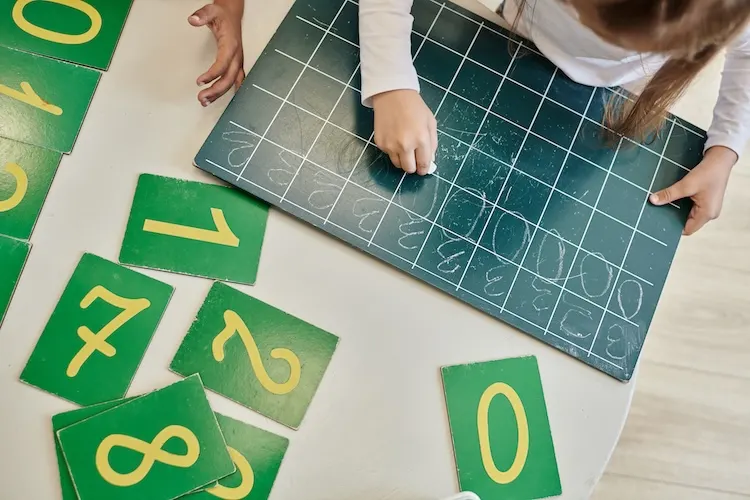
Encourage your child to trace the number while saying it aloud. This combines visual, motor, and auditory learning.
Step 3: Slowly Expand to 10 & Beyond
There is no need to rush.
Once your child is comfortable with numbers 1-5, gradually introduce 6-10 and eventually 1-20.
At this stage, a number chart for kids can become useful because it helps children visualise sequences and patterns.
How to Teach Counting to Toddlers & Preschoolers
Start with One-to-One Correspondence
One-to-one correspondence is one of the most important concepts in early maths.
Children should learn that one number word matches one object.
Instead of touching objects randomly while saying numbers, encourage them to count slowly and point to each item.
You can practise using:
- Fruits
- Toys
- Steps
- Spoons
- Building blocks
Use Everyday Opportunities
Formal lessons aren’t the only way to teach children. They learn numbers far better through everyday experiences.
Try counting:
- Steps while climbing stairs
- Rotis on the dinner table
- Cars in a parking lot
- Bananas in the fruit basket
- Books on a shelf
These natural interactions help kids understand that numbers are part of daily life.
Use Songs & Rhymes
Music makes learning memorable.
Rhythm and repetition strengthen memory and make counting enjoyable.
Popular number songs include:
- Five Little Monkeys
- Ten in the Bed
- One, Two, Buckle My Shoe
Fun Number Activities You Can Try at Home: Age-Wise Guide
For Toddlers (2-3 Years)
Toddlers learn best through touch and play activities. Tactile learning is the key to getting them started.
Here are some fun number activities to try at home with your toddler:
- Stacking Blocks: Count each block as your child stacks them.
- Number Puzzles: Wooden and foam puzzles introduce number shapes in a playful way.
- Finger Counting Games: Using fingers makes counting visual and easy to understand.
For Preschoolers (3-4 Years)
As children grow, they enjoy activities that combine movement and creativity. Here are some easy ones to try:
- Number Tracing: Tracing numbers strengthens fine motor skills and number recognition.
- Playdough Numbers: Rolling and shaping numbers with playdough makes learning tactile and enjoyable.
- Dice Games: Simple board games help children connect numbers with quantities.
For Kindergarteners (4-6 Years)
Older children can begin exploring patterns and basic arithmetic.
- Colouring Number Charts: Give your child a number chart and ask them to colour specific numbers or number patterns. This helps them recognise number sequences and spot patterns.
- Jumping Jack Counting: Turn counting into a physical movement game by asking your child to do jumping jacks while counting aloud.
- Simple Addition with Objects: Try questions like “Two apples plus three apples equals how many?” Using real objects makes abstract concepts easier to understand.
5 Common Mistakes to Avoid When Teaching Your Child Numbers
- Rushing Ahead Too Quickly: Strong foundation matters. Mastering numbers 1-10 is far more important than memorising numbers up to 100.
- Relying Only on Worksheets: Children learn best when they can touch, move, and explore. Hands-on experiences are just as important as written activities.
- Correcting Too Harshly: Mistakes are part of learning. Too much criticism can reduce confidence and make children anxious about maths.
- Focusing Only on Counting: Memorising numbers is not enough. Children also need to understand quantity and relationships between numbers.
- Comparing Your Child to Others: Every child develops differently. Comparisons often create unnecessary pressure and can affect confidence.
Help Your Child Build Strong Numeracy Skills with KLAY!
At KLAY, numbers are not taught through rote learning alone.
The curriculum follows a play-based approach where children naturally interact with numbers during stories, songs, games, art activities, and everyday classroom routines.
Visit your nearest KLAY centre and discover how play-based learning can make maths meaningful, enjoyable, and age-appropriate for your child!
Signs Your Child Is Developing Number Skills Well
Every child grows at a different pace. Here are some positive signs to look out for:
- Showing interest in counting objects.
- Recognising familiar numerals.
- Comparing quantities using words like “more” and “less”.
- Beginning to understand patterns and sequences.
- Using numbers naturally during play.
But when to seek support?
There is usually no reason to worry if progress seems slow.
However, if your child consistently struggles with recognising numbers, understanding quantities, or following age-appropriate milestones, speaking to a paediatrician, occupational therapist, or learning specialist can provide helpful guidance.
Early support is most effective when approached calmly and without pressure.
Frequently Asked Questions (FAQs):
How do I teach my 2-year-old numbers?
Start with numbers 1-5 using songs, finger counting, toys, and everyday objects. Keep the learning environment playful and pressure-free.
How do I teach a child who is struggling with numbers?
Slow down and focus on hands-on experiences. Games, songs, and visual aids often work better than worksheets alone.
Should I teach numbers or letters first?
Both can be introduced together. Young children naturally absorb language and mathematical concepts through play and daily interactions.
How long does it take for a child to learn numbers 1-10?
Every child learns at their own pace. Some learn within a few months, while others may take longer. Consistency is more important than speed.
What is the best way to develop number sense?
Using real objects and everyday experiences is one of the most effective ways to develop number sense. Children understand numbers better when they can see and touch quantities.
How many numbers should a 5-year-old know?
Many five-year-olds can count to 100 and understand simple addition concepts. However, understanding quantity and relationships between numbers is more important than memorising large sequences.











Subscribe to our newsletter
[contact-form-7 id="12706" title="Newsletter Form for post page"]Our Related Blogs
Yoga Benefits, Activities, and Poses for Preschoolers
For preschoolers, yoga isn’t about perfection but about giggles and benefits. So, are you curious how a simple stretch can support a child’s focus, flexibility, and emotional well-being? Let’s roll...
Year-End Reflection and Goal Setting for Children
Parenting is a journey filled with the brightest moments and valuable lessons, both for us and our children. As the year draws to a close, it’s the perfect time to...
Work-Life Balance Solutions for Parents in Emerald Hills Rd, Sector 65, Gurugram: The KLAY Daycare Advantage
Finding the perfect balance between professional commitments and parenting is a challenge for many working families in Gurugram. Parents in Emerald Hills Rd, Sector 65, especially, look for childcare solutions...