



 76767 08888




In India, early education is still evolving. The traditional learning systems often relied heavily on memorisation, but today there is a growing shift towards experiential and active learning in preschool.
Young children, in general, learn best through interaction, exploration, and play. This approach supports their cognitive as well as social-emotional development. In this blog, we explore the difference between rote learning and play-based learning and provide a practical perspective on how teachers and parents can adopt a more learner-centric approach.
What Is Play-Based Learning in Early Childhood Education?
Play-based learning is an approach where children learn through activities such as play, exploration, and interaction. Instead of memorising information, children actively engage with their environment.
The roots of this learning method are planted in experiential learning and constructivist theories, where children build knowledge through experiences.
Key Features of Play-Based Learning:
- Children learn through storytelling, building blocks, puzzles, and role play.
- Activities are often child-led and based on individual interests.
- Learning focuses on creativity, curiosity, and problem-solving.
- It supports communication, teamwork, and emotional development.
Through this child-centric learning approach, children become more active participants and less passive learners throughout their learning journey.
What Is Rote Learning in Preschools?
Rote learning is a traditional teaching method where children learn through repetition and memorisation. The focus is on whether the learners can recall information rather than understand concepts.
This method is still common in many classrooms, especially where academic outcomes are prioritised early.
Common Characteristics of Rote Learning:
- Children memorise the alphabet, numbers, or answers through repetition.
- Teaching is usually teacher-led and instruction-based.
- Activities often include drills, flashcards, and repetition exercises.
- The focus remains on correct answers rather than understanding.
While this method can help in memorising basic information, it may limit deeper learning and engagement.
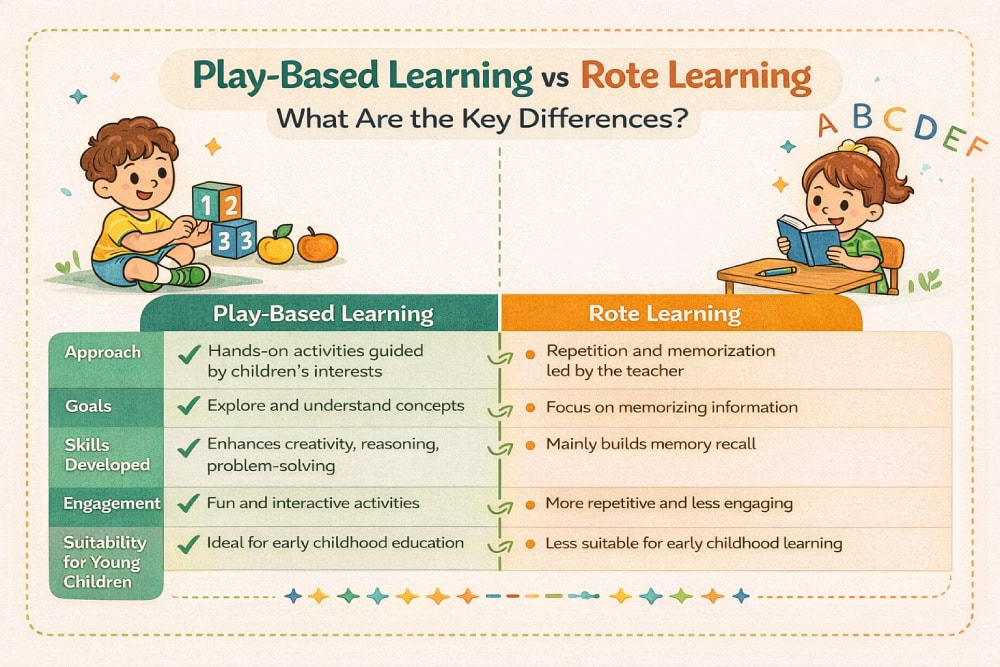
Play-Based Learning vs Rote Learning: What Are the Key Differences?
| Aspect | Play-Based Learning | Rote Learning |
| Teaching Style | Children learn through hands-on activities, play, and exploration guided by their interests | Learning is directed by the teacher, with repeated practice and memorisation |
| Learning Goal | Focuses on understanding ideas through real-life experiences and interactions | Focuses on remembering information such as letters, numbers, or answers |
| Thinking Skills | Builds reasoning, creativity, and problem-solving abilities | Mainly develops memory and recall skills |
| Retention | Children remember concepts better because they are actively involved in learning | Information is often remembered for a short time and may be forgotten quickly |
| Engagement Level | Activities feel enjoyable and interactive, keeping children involved | Learning can feel repetitive and less engaging for young children |
| Social & Emotional Growth | Encourages sharing, communication, and emotional understanding | Offers limited opportunities for social interaction or emotional development |
| Creativity | Supports imagination and encourages children to express ideas freely | Provides very little scope for creative thinking |
| Classroom Setting | Flexible and activity-driven environment where children explore freely | More structured environment with fixed instructions and routines |
| Role of Educator | The teacher acts as a guide who supports and observes the child’s learning process | The teacher leads the session and controls how learning happens |
| Suitability for Young Children | Well-suited for early childhood, as it matches how children naturally learn | Less effective when used as the main method for preschool learning |
How Parents & Teachers Can Apply These Insights in a Practical Manner
Understanding the two learning approaches for early childhood education is only the first step. Parents and educators need to understand practical ways to apply these methods to make a real difference. Here’s how:
- Encourage learning through play in daily routines by including storytelling, pretend play, and outdoor activities.
- Use structured activities when needed, but avoid over-reliance on memorisation.
- Look for preschools that follow a holistic development learning approach rather than focusing only on academics.
- Ask educators about their preschool curriculum approaches and how they balance play and structured learning.
- Choose environments that support both cognitive development and emotional well-being.
Read our complete guide to choosing the right preschool for your child for practical tips & expert insights.
Conclusion
Both approaches have a place in early education, but their impact is very different.
Play-based learning aligns more closely with how young children naturally learn. On the other hand, rote learning is useful in moderation for basic recall but should not be the primary method.
Ultimately, the goal of early childhood education is to create a balanced learning environment where children feel curious, confident, and excited to learn!










Subscribe to our newsletter
[contact-form-7 id="12706" title="Newsletter Form for post page"]Our Related Blogs
Yoga Benefits, Activities, and Poses for Preschoolers
For preschoolers, yoga isn’t about perfection but about giggles and benefits. So, are you curious how a simple stretch can support a child’s focus, flexibility, and emotional well-being? Let’s roll...
Year-End Reflection and Goal Setting for Children
Parenting is a journey filled with the brightest moments and valuable lessons, both for us and our children. As the year draws to a close, it’s the perfect time to...
Work-Life Balance Solutions for Parents in Emerald Hills Rd, Sector 65, Gurugram: The KLAY Daycare Advantage
Finding the perfect balance between professional commitments and parenting is a challenge for many working families in Gurugram. Parents in Emerald Hills Rd, Sector 65, especially, look for childcare solutions...