



 76767 08888



Key Takeaways
- Oval shape activities for preschoolers help children recognise geometric shapes, strengthen fine-motor skills, and build early spatial reasoning.
- Early shape learning supports foundational cognitive skills like pattern recognition and visual perception, which later benefit maths and writing. It connects directly to real-world understanding and school readiness, bridging play and early academic confidence.
- Children aged 2-3 begin by recognising shapes, while older preschoolers can trace and draw shapes independently.
- Simple, hands-on activities like shape hunts, crafts, and sensory play make learning engaging and effective.
Shape recognition is one of the first building blocks of early childhood learning. Before children learn letters or numbers, they learn to understand and talk about the world through shapes. Among these, the oval shape stands out because it is both simple and widely found in everyday objects.
In this guide, you’ll learn what an oval shape is, why it matters for preschool learning, how to introduce the shape effectively, and a range of oval shape activities for preschoolers that nurture both creativity and cognitive development.
What is an Oval Shape?
An oval shape is a two-dimensional form that looks like an elongated circle, similar to the shape of an egg. It has no straight lines or vertices, and it curves continuously around its perimeter. Unlike a circle, the distance from the centre to the boundary of an oval varies, which makes it slightly stretched or elongated compared to a perfect round shape.
Children encounter ovals in many objects around them. Examples include eggs, balloons, mirrors, spoons, and even some animal bodies. Because preschoolers often recognise shapes by comparing them with familiar objects, using these everyday items makes the concept of an oval easier to grasp.
How Does Shape Learning Support Early Development in Preschoolers?
Shape recognition forms an important foundation for early mathematics and spatial reasoning, which are essential for school readiness. Children who understand shapes can better recognise objects, categorise them, and solve problems related to space and direction. It builds critical cognitive skills that support later learning in maths, writing, and thinking.
Here are some key skills preschoolers develop through shape learning:
- Visual Perception: Children learn to see differences and similarities between shapes through careful observation.
- Spatial Reasoning: Understanding how shapes fit, rotate, and compare supports early geometry and problem-solving.
- Fine Motor Skills: Handling shapes, tracing, and manipulating materials strengthens the hands and fingers, which later helps with writing readiness.
- Early Maths Readiness: Recognising and sorting shapes is one of the first steps in early maths, which prepares children for more complex concepts like patterns and measurements.
- Pattern Recognition: Spotting shapes in the environment helps children link new learning to familiar patterns, reinforcing memory and classification skills.
Studies show that shape recognition activities, like oval shape recognition activities, especially those involving games and manipulation, significantly enhance children’s ability to identify geometric forms and improve their understanding of spatial properties.
Age-Wise Shape Learning Expectations
Understanding what preschoolers typically master at different ages helps tailor activities appropriately. Here’s a quick table for your understanding:
| Age Group | Expected Shape Skills |
| 2-3 Years | Begin to recognise simple shapes, including ovals and circles. |
| 3-4 Years | Trace large shape outlines and identify certain shapes in pictures. |
| 4-5 Years | Draw basic shapes, like an oval, independently and sort shape objects. |
| 6+ Years | Refine drawing shapes with control, compare shape properties, and relate shapes to early maths patterns. |
How Do You Introduce the Oval Shape to Preschoolers?
When introducing the oval shape to children aged 3 to 6 years (the preschool age), it helps to connect the shape to real things they see daily. Here’s how you can get started:
- Start by showing them a concrete object that is clearly oval, such as an egg or a balloon, and naming the shape in a simple sentence.
- Then, gradually show other objects and invite children to notice the similarities and differences.
It is also wise to incorporate activities that help recognise oval shapes in a preschooler’s daily routine to make them familiar with the shape.
Oval Shape Activities for Preschoolers
-
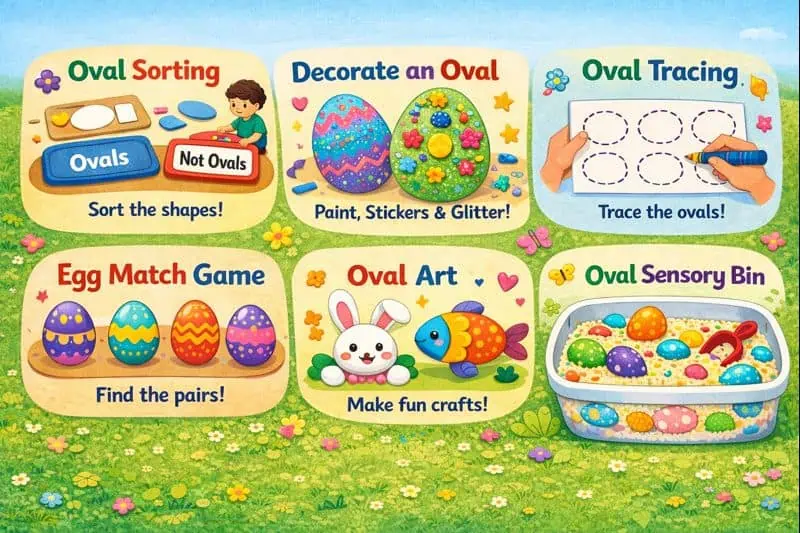
Oval Shape Hunt
What it is: A simple shape-finding activity where children look around their environment to spot ovals.
What you need: Oval objects such as eggs, balloons, mirrors, or plastic toys.
How to do it: Show children an oval object and explain its shape. Encourage them to find more ovals around the room, home, or playground.
How it helps: This oval shape activity builds shape recognition and boosts observational skills in a real-world context.
-
Oval Collage
What it is: A creative craft where children glue oval cut-outs to make colourful art.
What you need: Coloured paper, scissors, glue, and a large sheet of paper.
How to do it: Cut paper into various oval shapes and let children arrange and stick them on a large sheet. They can create patterns, faces, or abstract designs.
How it helps: This oval shape craft activity for preschoolers enhances creativity, strengthens fine-motor skills, and reinforces recognition of the oval shape.
-
Oval Tracing
What it is: A tracing activity that helps children practise drawing the oval shape.
What you need: Sheets with large oval outlines and crayons or markers.
How to do it: Provide children with sheets and encourage them to trace the outlines slowly and carefully.
How it helps: This strengthens hand-eye coordination and builds confidence in early writing movements.
-
Oval Snacks
What it is: A sensory learning activity involving food.
What you need: Oval-shaped foods like sliced cucumbers (cut into oval shape), eggs, or oval cookies.
How to do it: Before eating, talk about the shape of each food item and compare it with other shapes.
How it helps: This combines learning with sensory experience, making shape recognition more memorable.
-
Playdough Creations
What it is: A hands-on sculpting activity that lets children mould shapes.
What you need: Playdough or modelling clay.
How to do it: Let children roll and shape the playdough into ovals. Encourage them to make animals, eggs, or other objects using ovals.
How it helps: This activity for oval shape recognition builds fine motor strength and creativity while reinforcing shape properties.
-
Storytime With Ovals
What it is: Shape discovery through shared reading.
What you need: Books with pictures that feature ovals (faces, eggs, objects).
How to do it: Read the book with children, and pause to invite them to spot oval shapes in illustrations.
How it helps: This deepens language comprehension and helps children connect shape learning with stories and visuals.
-
Oval Puzzles
What it is: Puzzle activity with oval pieces.
What you need: Oval-shaped puzzles or images containing ovals.
How to do it: Provide puzzles that focus on oval shapes and let children assemble them.
How it helps: This boosts spatial reasoning and reinforces shape identification.
-
Oval Stamping
What it is: Stamp art with oval-shaped stamps.
What you need: Oval stamps, ink pads, and paper.
How to do it: Let children press oval stamps onto paper to create patterns or pictures.
How it helps: This activity for oval shape recognition enhances dexterity, artistic expression, and familiarity with the oval form.
-
Oval Sorting
What it is: A sorting activity involving mixed shapes.
What you need: A collection of shapes, including ovals, circles, and squares.
How to do it: Ask children to separate the oval shapes from the others.
How it helps: This sharpens observation, classification skills, and concept differentiation.
-
Spot Ovals in Everyday Objects
What it is: Shape exploration in the real world.
What you need: Everyday items of various shapes.
How to do it: Together with children, explore and name objects that are oval in daily life, such as racetracks or eyes in pictures.
How it helps: This activity connects learning to the real world and improves shape awareness.
-
Building With Ovals
What it is: Creative construction with oval blocks.
What you need: Oval-shaped blocks or craft materials.
How to do it: Let children stack and build structures using oval pieces.
How it helps: This oval shape recognition activity strengthens coordination, planning, and creativity.
-
Collaborative Murals
What it is: Group art with ovals.
What you need: Large paper, paints, and collage materials.
How to do it: Guide children to paint and glue ovals together on a large mural.
How it helps: This promotes teamwork, artistic expression, and social interaction.
-
Outdoor Games with Ovals
What it is: Play using oval objects outside.
What you need: Oval-shaped balls or objects.
How to do it: Use oval balls for games like catch or rolling races.
How it helps: This develops gross motor skills and reinforces shape familiarity.
Importance of Oval Shape Activities in Preschoolers
-
-
- Helps Differentiate Between Similar Curved Shapes: Ovals look very similar to circles, so practising oval shape recognition activities sharpens a child’s ability to notice small differences in shapes, improving their visual discrimination skills.
- Strengthens Pre-Writing Curves and Continuous Motion Control: Oval strokes mimic the smooth, rounded movements needed for writing letters like o, a, d, and g, so oval tracing and drawing build early handwriting readiness.
- Encourages Observation of Non-Symmetrical Shapes: Unlike the perfect symmetry of a circle, ovals teach children that shapes can stretch, vary, and still be classified. This deepens their understanding of irregular forms.
- Improves Real-World Shape Recognition: Ovals appear frequently in daily life, eggs, mirrors, balloons, leaves, snacks, etc., so oval shape recognition activities help children connect classroom learning with their environment.
- Supports Bilateral Coordination: Oval shape recognition activities like drawing, stamping, or shaping require both hands to work together, which strengthens the bilateral coordination essential for writing, dressing, and other daily tasks.
-
Conclusion
Learning about shapes forms a core part of early childhood development, and oval shape activities for preschoolers make this learning playful and impactful. When children explore shapes through real objects, hands-on crafts, stories, and games, they build confidence, sharpen observational skills, and strengthen foundational thinking abilities.
At KLAY, we believe in nurturing children’s learning through purposeful play and curiosity-driven exploration. Our holistic approach combines shape learning with sensory experiences, creativity, and social interaction so that every child grows with confidence and a love for learning.
Explore KLAY’s holistic preschool programme to nurture early learning and creativity with fun, hands-on activities.
FAQs
-
-
-
What are some simple oval activities for preschoolers?
Simple oval activities for preschoolers include tracing and drawing ovals on paper, creating oval-shaped collages, and sorting oval toys or objects during play. These are easy to set up and help children become familiar with the shape through practice and exploration.
-
What is an oval shape for kids?
An oval shape is a two-dimensional figure that looks like a stretched or elongated circle, similar to an egg. It has no vertices or straight sides but curves continuously around its outline. In three dimensions, this shape is sometimes called an ovoid.
-
-









Subscribe to our newsletter
[contact-form-7 id="12706" title="Newsletter Form for post page"]Our Related Blogs
Yoga Benefits, Activities, and Poses for Preschoolers
For preschoolers, yoga isn’t about perfection but about giggles and benefits. So, are you curious how a simple stretch can support a child’s focus, flexibility, and emotional well-being? Let’s roll...
Year-End Reflection and Goal Setting for Children
Parenting is a journey filled with the brightest moments and valuable lessons, both for us and our children. As the year draws to a close, it’s the perfect time to...
Work-Life Balance Solutions for Parents in Emerald Hills Rd, Sector 65, Gurugram: The KLAY Daycare Advantage
Finding the perfect balance between professional commitments and parenting is a challenge for many working families in Gurugram. Parents in Emerald Hills Rd, Sector 65, especially, look for childcare solutions...