



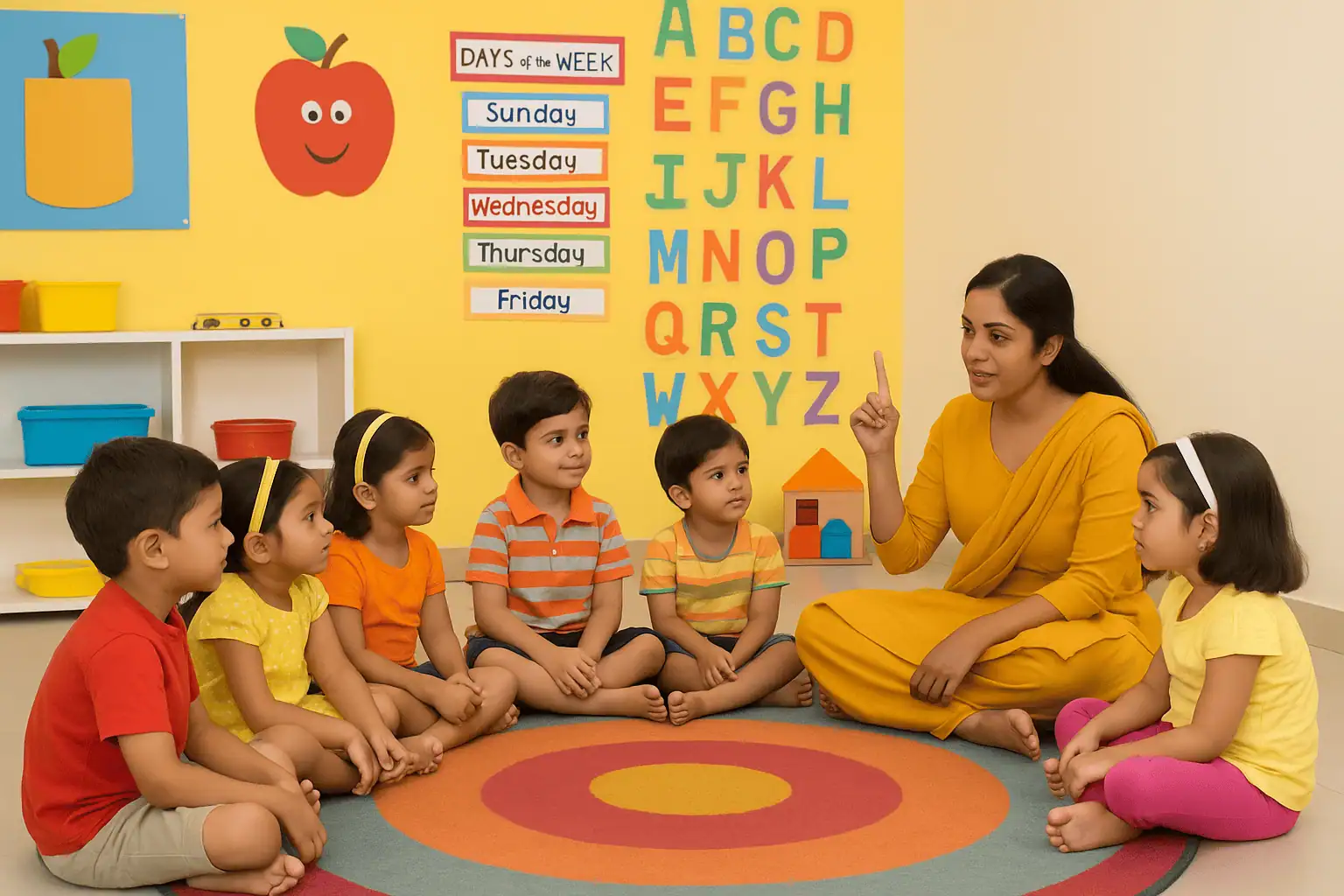


Key Takeaways
- Circle time in preschool nurtures children’s social, emotional, and language growth. It helps them build focus, patience, and respect for group rules.
- Teachers can use songs, rhymes, and calendar talk to spark early learning.
- A well-structured circle time boosts classroom harmony and prepares children for formal schooling.
- At KLAY, circle time connects learning, play, and daily routines to make every morning meaningful.
If you’ve ever peeked into a preschool classroom first thing in the morning, you’ve probably seen children sitting together in a small circle, greeting each other with big smiles and cheerful songs. That warm, welcoming moment is called circle time, and it’s one of the most impactful parts of a preschooler’s day.
What is Circle Time in Preschool?
Circle time in preschool is a structured group gathering activity followed daily, where children and teachers sit together in a circle for a specific duration. During this time, they share information, play games, sing songs, discuss the day’s topic, and bond before starting their activities.
It’s not just about “sitting in a circle”, but it’s more of a carefully designed teaching moment that balances learning with fun. This helps children build a sense of community, develop a routine, and learn important social skills.
What are the Benefits of Circle Time in Preschool?
Preschool circle time has many benefits that go beyond academics. It shapes how young children think, feel, and connect with others, laying the groundwork for lifelong social and learning skills.
Social & Emotional Growth
According to Vygotsky’s Sociocultural Theory, children go through the best cognitive development when they interact with adults, like their parents or teachers. That’s why circle time can benefit preschoolers big time as they learn to share their ideas, listen to others respectfully, and express their feelings in a socially accepted way.
Teachers can begin their interactions with kids by asking, “How are you feeling today?” to help them recognise their emotions.
Also Read: Social-Emotional Skills for PreschoolersLanguage & Communication
Circle time in preschools means more interaction with their peers and teachers. This allows kids to get a good command of their language and communication skills as they see their teachers model correct pronunciation and sentence patterns. So, whether your circle time involves singing songs and rhymes or having simple discussions, it strengthens a child’s vocabulary and confidence.
Related Read: Communication Skills for ChildrenCognitive & Pre-Academic Development
Circle time activities like calendar talks, counting days, identifying seasons, and sequencing events introduce kids to early maths and logic concepts. Repetitive patterns help improve their memory and reasoning. These early thinking experiences encourage curiosity, help children connect concepts, and prepare them for structured academic learning later on.
Self-Regulation & Attention
Research published in the National Library of Medicine suggests that the majority of children develop self-regulation rapidly during early childhood. Circle time in preschools only fuels this development further.
It teaches children to wait their turn, follow group rules, and focus during short discussions. These are key readiness skills for classroom learning. Over time, children learn to control impulses, transition smoothly between tasks, and develop patience, which is vital for thriving in group settings.
Physical & Motor Development
Short movement breaks, action songs, and gesture rhymes strengthen fine and gross motor coordination. These activities help children refine their physical coordination and hand-eye control while becoming more aware of body movement. All of this supports the development of Howard Gardner’s Bodily-Kinesthetic Intelligence, one of the multiple intelligences in kids.
Cultural Awareness & Respect
Preschool circle time allows children to be exposed to stories, songs, and festivals from different regions and cultures. When this happens, they develop an appreciation for diversity and harmony. It builds early cultural sensitivity, encouraging children to respect traditions and perspectives different from their own, promoting inclusivity from a young age.
What to Do During Circle Time?
A well-planned preschool circle time keeps young learners active and engaged. There should be a mix of passive and active activities that foster a sense of community, learning, and routine. It’s ideal to have a 15-20 minute session that includes some of the following elements:
- Greeting & Welcome Song: A cheerful tune to start the day with energy.
- Sharing Feelings & Weather Talk: Children express how they feel and describe the day’s weather.
- Calendar Talk: Discussions about the day, date, month, and year reinforce sequencing and awareness of time.
- Rhymes or Finger Plays: Playful learning helps build rhythm and memory.
- Movement Break: Quick stretching or dancing to reset focus.
- Closing Song or Transition: This signals the shift to snack or the next activity.
The duration and activities vary by age. Younger preschoolers may need shorter, more energetic sessions, while older children can participate in slightly longer discussions.
Circle Time at KLAY
At KLAY Preschools, circle time is the heart of the daily routine. Teachers use songs, storytelling, and visual aids to make every session meaningful. Children start their day with a familiar structure that helps them feel secure and excited to learn. Circle time also proves to be an important part of our approach to positive preschool classroom management strategies.
Do’s & Don’ts of Circle Time at Preschool
Here’s a quick overview of what to include and not to include in your circle time activities:
Do’s of Circle Time
- Use local context and examples: Talk about nearby festivals or today’s weather to make discussions relatable and engaging.
- Add visual charts with bilingual labels: This supports language development and inclusivity for all learners.
- Rotate helper roles: Giving children small responsibilities builds confidence and leadership. Keep rotating the helper roles to give every child a chance.
- Keep sessions short initially, then gradually extend: This helps younger preschoolers adjust to routines without losing focus.
- Include movement breaks: Short stretches or action songs help children release energy and refocus attention.
- Model listening and participation: When teachers actively listen and engage, children mirror those positive behaviours.
Don’ts of Circle Time
- Don’t make sessions too long for younger children: Their attention spans are short, and long sessions can lead to restlessness.
- Don’t rely only on teacher talk: Interactive questioning and peer sharing make circle time more meaningful.
- Don’t overlook shy children: Allow them to pass or join later so participation feels safe, not forced.
- Don’t leave the group unattended: Prepare beforehand to keep the session smooth and structured.
Quick Tips & Sample Circle Time Plans
What to Include in Your Preschool Circle Time
Standard 15-20 Minutes Plan
- Greeting song (2 min)
- Weather & feelings chart (3 min)
- Calendar talk (3 min)
- Rhyme or story (4 min)
- Movement break (3 min)
- Closing song/transition (3 min)
Shorter 10-Minute Plan (for younger preschoolers)
- Hello song (2 min)
- Weather talk (2 min)
- One rhyme or fingerplay (3 min)
- Stretch and wrap up (3 min)
Extended 25-30 Minutes Plan (for older preschoolers)
- Greeting and attendance (3 min)
- Feelings & calendar talk (5 min)
- Story or rhyme (7 min)
- Movement activity (5 min)
- Mini discussion or sharing (5 min)
- Closing routine (3-5 min)
Practical Tips for Teachers
- Use a bell, chime, or familiar song to begin circle time: This signals a consistent start and helps children transition smoothly from free play to group time.
- Mark individual sitting spots on the floor for easy settling: Gives each child a sense of personal space and reduces crowding or distractions.
- Display a visual schedule showing the order of activities: Helps children anticipate what comes next, creating comfort and structure.
- Use bilingual prompts to include every child: Supports language development and ensures inclusivity for multilingual classrooms.
- Balance calm & active segments for smooth transitions: Keeps the group engaged while managing energy levels effectively.
How to Reflect & Improve Your Preschool Circle Time
Reflection is key to making circle time truly effective. Regularly reflecting on your preschool circle time helps you fine-tune it to suit your group’s energy and developmental stage. After each session:
- Observe children’s engagement and how smoothly transitions happen.
- Note what worked. Was that song too long, or did that rhyme get everyone moving? Keep a note of everything for your reference.
- Ask simple feedback: “What was your favourite part today?”
- Adjust the plan based on the season, festivals, or classroom mood.
Conclusion
Circle time in preschool is where learning, language, emotions, and friendship meet. It’s a window into how children think, respond, and relate. And for kids, this little morning ritual becomes a moment that turns every school day into a shared adventure!








Subscribe to our newsletter
[contact-form-7 id="12706" title="Newsletter Form for post page"]Our Related Blogs
Yoga Benefits, Activities, and Poses for Preschoolers
For preschoolers, yoga isn’t about perfection but about giggles and benefits. So, are you curious how a simple stretch can support a child’s focus, flexibility, and emotional well-being? Let’s roll...
Year-End Reflection and Goal Setting for Children
Parenting is a journey filled with the brightest moments and valuable lessons, both for us and our children. As the year draws to a close, it’s the perfect time to...
Work-Life Balance Solutions for Parents in Emerald Hills Rd, Sector 65, Gurugram: The KLAY Daycare Advantage
Finding the perfect balance between professional commitments and parenting is a challenge for many working families in Gurugram. Parents in Emerald Hills Rd, Sector 65, especially, look for childcare solutions...