



 76767 08888



Key Takeaways
-
- NEP 2020 places greater importance on early childhood care and education (ECCE) and puts the early years at the centre of India’s education framework.
- The NCF Foundational Stage 2022 covers children from ages 3 to 8 and provides guidance for learning across preschool and the early primary years.
- Play-based learning, exploration, stories, music, activities, and hands-on experiences have an important place in the Foundational Stage.
- Parents can expect greater attention to children’s cognitive, language, physical, social, emotional, and creative development instead of a narrow focus on academics.
- Families can support this approach at home through reading, conversations, play, everyday routines, and opportunities for children to explore independently.
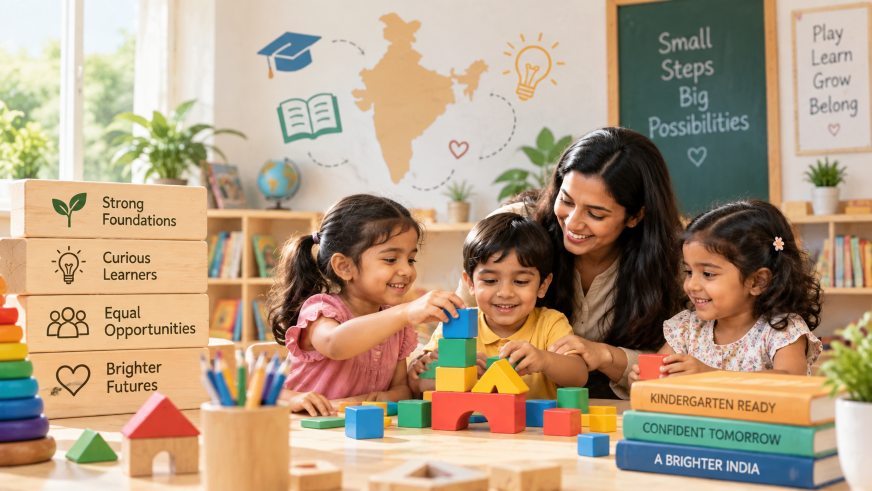
India’s approach to early education is moving towards learning that is more age-appropriate, holistic, and play-based. NEP 2020 recognises early childhood as an important stage of education, while the NCF-FS 2022 (National Curriculum Framework-Foundational Stage) provides a curriculum framework for children aged 3 to 8.
What Are NEP 2020 & the NCF Foundational Stage 2022?
Before looking at what these changes mean for your child’s preschool experience, it helps to understand what each framework does.
NEP 2020: India’s New Education Direction
The National Education Policy 2020 introduced a new approach to education in India, including a stronger focus on early childhood care and education.
- It places children aged 3-8 within the foundational stage of the new 5+3+3+4 curricular structure.
- The policy gives early learning greater importance because development during these years lays the groundwork for later learning.
- It also highlights foundational literacy and numeracy as important educational goals.
NCF Foundational Stage 2022: Turning Policy Into Practice
The National Curriculum Framework for Foundational Stage 2022 was developed to put the early childhood vision of NEP 2020 into practice.
- It covers a five-year Foundational Stage for children aged 3-8, including three years of preschool or early childhood education followed by Grades 1 and 2.
- It provides guidance on what children should learn and how teachers can create developmentally appropriate learning experiences.
- This framework places play and activity at the heart of learning.
Importance of Early Years in the NEP 2020
The early years are a period of rapid development.
NEP 2020 emphasises the importance of quality early childhood care and education that builds strong foundations before children move into more formal stages of schooling.
Here, the focus is not simply on teaching children more.
Instead, the framework encourages experiences that support cognitive, language, physical, social, emotional, and other areas of development. The framework that puts NEP into action also recognises that children develop at different rates, so learning outcomes should be viewed as a developmental continuum rather than rigid age-specific targets.
Want to Understand Why the Early Years Matter in Education? Explore our guide to early childhood education and discover how these formative years shape your child’s learning, development, and future success.
How NEP 2020 Could Shape Your Child’s Preschool Experience
The shift towards a more holistic preschool curriculum approach can change what children do and how they learn during the school day.
1. Learning Through Play & Everyday Activities
Play-based learning is central to the new framework. Children can learn through stories, rhymes, music, games, exploration, conversations, and hands-on activities rather than relying only on direct instruction.
2. Development Goes Beyond Early Academics
A child’s preschool experience can include opportunities to develop language, thinking, physical abilities, social and emotional skills, creativity, and sensory awareness. The aim is holistic development, rather than focusing only on academic growth.
3. Children Can Learn at a Developmentally Appropriate Pace
The NCF Foundational Stage recognises that not all children reach every expected learning outcome at exactly the same age. The framework presents learning as a developmental progression, allowing teachers to respond to individual children’s needs and readiness.
What Does the NEP 2020 & NCF Foundational Stage Mean for Parents?
These changes don’t just affect the learning environment inside a preschool. Parents also have an important role in supporting children’s learning.
1. Parents & Teachers Can Work More Closely Together
The NCF recognises families and communities as partners in children’s learning. Regular communication between parents and teachers can help families understand what their child is learning and how they can support it at home.
2. Progress Is Not Just About Acing Tests
At the Foundational Stage, teachers can observe children’s development through their everyday participation, activities, conversations, and work. The NCF emphasises observable learning outcomes and developmental progress rather than treating learning as a series of rigid age-based targets.
3. Children’s Interests & Readiness Matter
A child-centred learning environment gives children opportunities to explore, ask questions, make choices, and learn through experiences suited to their developmental stage. Teachers can provide guidance and support without taking away these exploration opportunities.
Choosing a preschool curriculum can feel overwhelming. Learn about the different preschool programmes and teaching approaches to find the best fit for your child’s interests, learning style, and developmental needs.
How to Bring NEP-Aligned Learning at Home
With the changes in early childhood care and education, you don’t have to necessarily recreate classroom-style learning at home. Here’s how you can make learning more fun and aligned with the principles of NEP 2020:
- Make room for play and curiosity. Let your child explore toys, household objects, art materials, and their surroundings without expecting every activity to have a fixed learning outcome.
- Read together every day. Storybooks introduce new words, ideas, characters, and situations while helping your child develop the ability to listen, talk, imagine, and ask questions.
- Talk to your child while doing your everyday routine. Conversations during meals, travel, shopping, or walks can help children build vocabulary and express their thoughts.
- Let children do small things independently. Simple tasks such as putting away toys, choosing clothes, or helping set the table can build their confidence and allow them to become more independent.
- Keep academic pressure low. Instead of rushing into formal learning, give children time to build foundational skills through play, conversation, stories, movement, and hands-on experiences.
What to Look for in a Preschool?
- Play-Based Curriculum: Look for a preschool where children learn through play, stories, exploration, activities, and hands-on experiences rather than relying mainly on worksheets.
- Qualified Early Childhood Educators: Teachers should understand young children’s developmental needs and know how to support learning through age-appropriate experiences.
- Safe & Engaging Spaces: Children need environments where they can move, explore, interact with others, and access learning materials safely.
- Parent Involvement: A good preschool should keep parents informed about their child’s experiences and provide practical ways to support learning at home.
- Holistic Approach: Look beyond early academics and consider whether the programme supports language, cognitive, physical, social, emotional, and creative development.
Why Choose KLAY for Your Little One?
At KLAY, children learn through play, exploration, and age-appropriate experiences designed to support holistic early learning. Our approach focuses on creating meaningful learning experiences that help children build confidence, curiosity, and strong foundations for the years ahead.
Looking for a preschool that reflects the vision of NEP 2020? At KLAY Preschools, children learn through play, exploration, and age-appropriate experiences that support holistic development and build a strong foundation for lifelong learning.
FAQs:
1. What age group comes under the Foundational Stage?
The Foundational Stage covers children from 3 to 8 years of age. It includes three years of preschool or early childhood education followed by Grades 1 and 2.
2. How is NEP 2020 different from the NCF Foundational Stage 2022?
NEP 2020 is the broader national education policy that sets the direction for education, including early childhood education. The NCF Foundational Stage 2022 provides a curriculum framework to help translate that vision into learning experiences for children aged 3-8.
3. Does NEP 2020 mean less academic learning in preschool?
It does not mean that children stop learning foundational academic concepts. Instead, this policy for early childhood education encourages these foundations to be developed through developmentally appropriate, play- and activity-based experiences rather than excessive formal instruction.
4. How can parents support NEP-aligned learning at home?
Parents can support learning through reading, conversations, play, storytelling, everyday routines, creative activities, and opportunities for children to explore independently. These experiences can help your child build their language, thinking, social, and other foundational skills more naturally and without major academic stress.
5. How can I tell whether a preschool follows NEP 2020?
Ask the preschool how its preschool curriculum approaches play, foundational learning, assessment, teacher-child interactions, and holistic development. You can also ask how teachers observe children’s progress and how the school involves parents in their child’s learning process.






Subscribe to our newsletter
[contact-form-7 id="12706" title="Newsletter Form for post page"]Our Related Blogs
Yoga Benefits, Activities, and Poses for Preschoolers
For preschoolers, yoga isn’t about perfection but about giggles and benefits. So, are you curious how a simple stretch can support a child’s focus, flexibility, and emotional well-being? Let’s roll...
Year-End Reflection and Goal Setting for Children
Parenting is a journey filled with the brightest moments and valuable lessons, both for us and our children. As the year draws to a close, it’s the perfect time to...
Work-Life Balance Solutions for Parents in Emerald Hills Rd, Sector 65, Gurugram: The KLAY Daycare Advantage
Finding the perfect balance between professional commitments and parenting is a challenge for many working families in Gurugram. Parents in Emerald Hills Rd, Sector 65, especially, look for childcare solutions...