



 76767 08888



Key Takeaways:
-
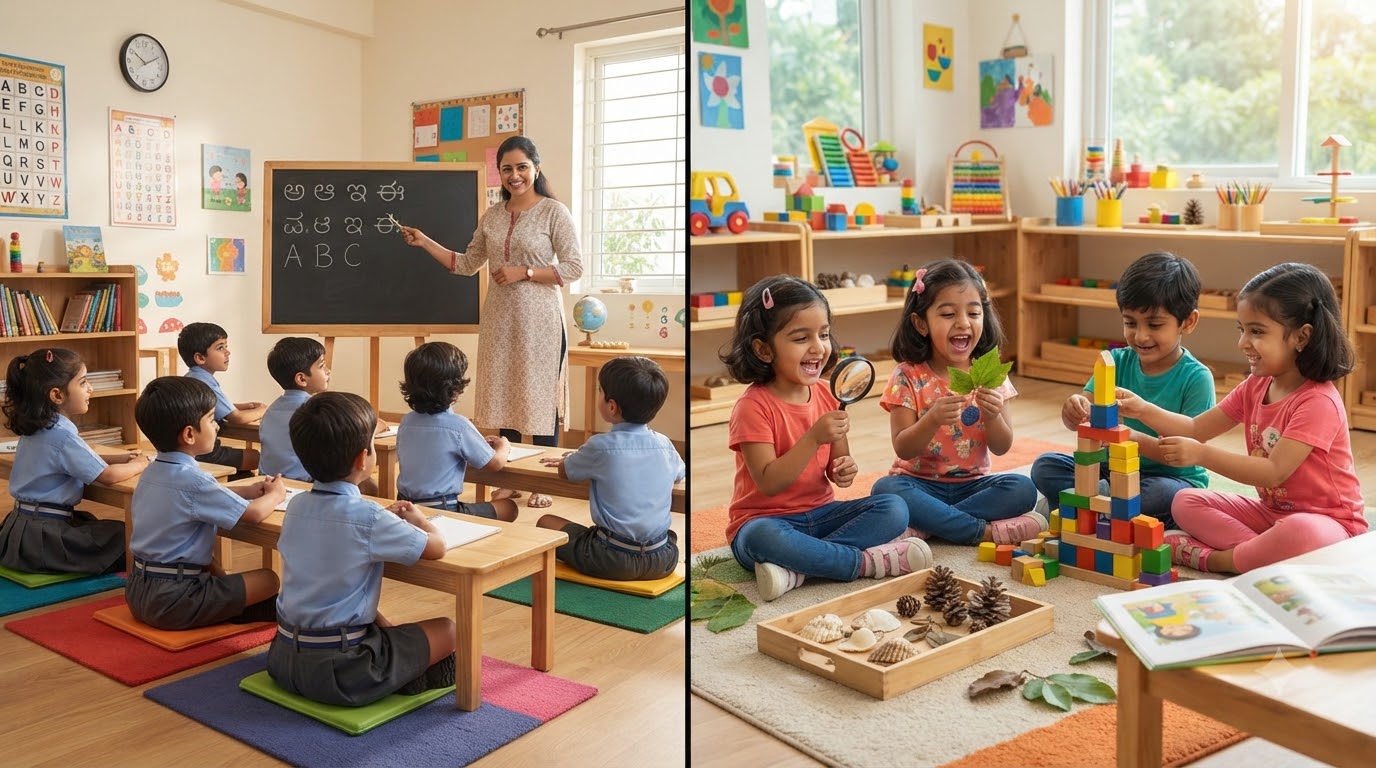
Rote learning helps children remember basic information through repetition, while conceptual learning focuses on understanding ideas and how they work.
-
Both approaches have a place in early childhood learning, but young children benefit greatly from learning through play, exploration, and real-life experiences. -
Memorising songs, rhymes, letters, numbers, and simple facts can still be useful when it supports broader understanding. -
Parents can encourage meaningful learning at home through everyday activities such as sorting, counting, storytelling, cooking, and pretend play.
Children learn something new every day. They may memorise a rhyme, recognise a colour, count their toys, or ask why the moon appears in the sky. But there is a difference between remembering an answer and understanding what it means.
This is where the discussion around rote learning and conceptual learning becomes important for parents.
What Is Rote Learning?
Rote learning is a method in which children remember information through repetition. They may repeat a word, number, song, or fact several times until they can recall it.
For preschoolers, common examples include:
- Memorising and reciting the alphabet from A to Z.
- Reciting numbers from one to ten or beyond.
- Learning the days of the week through repetition.
- Repeating poems, songs, and nursery rhymes.
- Memorising the names of colours.
It’s not entirely bad. Repetition can help young children remember basic information, particularly songs, rhymes, simple facts, and familiar sequences.
But the concern arises when memorisation becomes the main way children are expected to learn without opportunities to understand or apply what they have learnt.
What Is Conceptual Learning?
It focuses on helping children understand an idea rather than simply remember an answer. Children learn by observing, exploring, asking questions, making connections, and using what they discover.
For example, instead of simply teaching a child that “2 + 3 = 5”, you could give them two toy cars and then three more. When they put the cars together and count all five, they begin to understand what addition means.
Other examples include:
- Learning colours by sorting toys into different colour groups.
- Understanding shapes by finding circles, squares, and triangles around the classroom.
- Learning letters through stories, songs, objects, and activities.
- Counting actual objects instead of simply reciting numbers.
Rote Learning vs Conceptual Learning: What’s the Difference?
| Aspect | Rote Learning | Conceptual Learning |
| Focus | Focuses primarily on remembering information. | Focuses on understanding ideas and relationships. |
| Learning Method | Children learn through repetition and recall. | Children learn through exploration, experiences, questions, and practice. |
| Child’s Role | The child may have fewer opportunities to actively explore the idea. | The child takes an active role in discovering and using what they learn. |
| Problem-Solving | Memorised information may not always help children handle a new problem. | Understanding helps children apply ideas to simple new situations. |
| Memory | It can support quick recall of familiar information. | Understanding can help children connect new information with what they already know. |
| Curiosity | Repetition alone may provide fewer opportunities to explore. | Questions and discovery naturally encourage curiosity. |
| Real-Life Application | Children may find it harder to apply information learnt only through repetition. | Children can connect concepts with everyday experiences more easily. |
| Preschool Use | It is useful for selected facts, songs, rhymes, and sequences. | It is particularly valuable for building understanding through age-appropriate experiences. |
The goal does not have to be choosing one method and rejecting the other. A balanced approach can use memorisation where it is helpful while giving children plenty of opportunities to understand and apply what they learn.
Why Does Understanding Concepts Matter During Preschool Years?
Preschoolers are naturally active learners. They observe what happens around them, ask questions, touch objects, experiment with ideas, and learn through play.
Conceptual learning works well with these natural learning behaviours because it allows children to make sense of experiences rather than simply repeat information.
It can support:
- Cognitive Development: Children practise making connections, recognising relationships, and understanding patterns.
- Language Development: Conversations around everyday experiences introduce children to new vocabulary and help them explain their thoughts.
- Problem-Solving: Children get opportunities to think independently and try different ways to solve simple challenges.
- Creativity: Open-ended activities allow children to explore different possibilities rather than look for only one correct response.
- Confidence: Understanding how and why something works can give children the confidence to use their knowledge in new situations.
Does Rote Learning Still Have a Place in Preschools?
Yes. Rote learning can be useful when children need to remember simple information that supports everyday learning.
For example, children may memorise:
- Nursery rhymes and songs.
- Simple safety rules.
- Phone numbers of their parents/guardians when they are developmentally ready.
- Alphabet songs.
- Days of the week and months of the year.
- Basic counting sequences.
Memorisation works best when it supports understanding rather than replacing it.
How Play-Based Learning Helps Preschoolers Understand Concepts
1. Stories Can Build Language & Understanding
Storytelling helps children understand emotions, new vocabulary, and the sequence of events.
2. Building Blocks Can Teach Practical Concepts
Blocks introduce children to shapes, balance, spatial awareness, and simple problem-solving. Children learn by building, changing, testing, and rebuilding their creations.
3. Pretend Play Connects Learning with Real Life
Pretend play allows children to explore familiar roles, such as a doctor, shopkeeper, teacher, or cook. It can help them practise language, social interaction, counting, decision-making, and everyday problem-solving.
4. Nature Walks Turn the Outdoors Into a Classroom
A walk can encourage children to observe plants, birds, insects, weather, colours, and sounds. Adults can ask questions that encourage children to notice details and explain what they see.
5. Art & Craft Fuels Creativity
Drawing, painting, and craft activities can introduce children to various colours and patterns while supporting creativity and fine motor skills. Children also get the opportunity to make choices and express their ideas.
Related Read: Play-Based Learning vs Rote Learning
How to Encourage Conceptual Learning at Home: Simple Activities to Try
- Count Everyday Objects: Ask your child to count fruits while shopping or count plates while setting the table. This helps connect numbers with real objects.
- Sort Household Items: Invite your child to sort safe household objects by colour, size, or shape. Ask them why they placed certain objects together.
- Ask Open-Ended Questions: Questions such as “What do you think will happen?” and “Why did this happen?” encourage children to think, predict, and explain.
- Make Storytime Interactive: While reading, ask your child what they think might happen next or why a character made a particular choice. This encourages them to connect events and express their ideas.
- Cook Together: Ask your child to count the spoons of flour or sugar you add while cooking. This introduces them to concepts like measurement and counting. For example, your child can count spoons of flour while you talk about how the mixture changes after each ingredient is added.
Signs That Your Child Is Learning By Understanding Concepts
Your child may be developing conceptual understanding when they begin to do more than repeat an answer. Look for signs such as:
- They ask questions such as “why” and “how”.
- They explain an idea using their own words.
- They try to solve simple problems independently.
- They use what they have learnt in everyday situations.
- They connect one idea with another.
- They enjoy exploring, experimenting, and finding out what happens.
Every child develops differently, so these signs should be viewed as examples rather than a checklist that children must meet at a particular age.
Common Mistakes Parents Can Avoid
Parents naturally want their children to be ready for school, but too much academic pressure can make learning feel like a task rather than an enjoyable experience.
Try to avoid:
- Expecting children to memorise every piece of information.
- Relying only on worksheets and repetitive exercises.
- Comparing your child’s progress with that of other children.
- Correcting every mistake immediately instead of allowing children to think.
- Focusing on marks or correct answers at the expense of curiosity.
- Rushing formal academic learning before children are ready.
Instead, give them opportunities to explore, make mistakes, ask questions, and try again.
How KLAY Makes Conceptual Learning Part of Everyday Play
At KLAY, learning is designed to go beyond memorising facts. A play-based learning approach gives children opportunities to explore ideas through hands-on experiences and meaningful activities.
Children can learn through storytelling, sensory experiences, activity-based learning, inquiry-led exploration, building, creative activities, and teacher-guided discovery. These experiences support holistic development across language, cognitive, social-emotional, and physical areas.
FAQs:
1. What is the difference between rote learning and conceptual learning?
Rote learning focuses on remembering information through repetition, while conceptual learning focuses on understanding ideas and applying them to different situations. Both can have a role in a child’s education.
2. Is rote learning harmful for preschool children?
Rote learning is not inherently harmful. Repetition can help children remember songs, rhymes, sequences, and simple facts. However, preschool learning should not rely on memorisation alone.
3. Why is conceptual learning important in early childhood?
It helps children understand relationships, ask questions, solve simple problems, make connections, and use what they learn in everyday situations. These experiences can support broader development during the early years.
4. How does play-based learning support conceptual understanding?
It allows children to explore ideas through stories, games, building, pretend play, art, nature, and hands-on experiences. Instead of simply memorising information, children can discover how concepts work through experience.
5. Can rote learning and conceptual learning be used together?
Yes. Children can memorise useful information while also developing an understanding of what it means. For example, they can learn to recite numbers while using objects to understand quantity and counting.
6. How can parents encourage conceptual learning at home?
Parents can use everyday activities such as shopping, cooking, reading, sorting, counting, outdoor exploration, and pretend play. Asking open-ended questions and encouraging children to explain their thinking can make these activities even more meaningful.










Subscribe to our newsletter
[contact-form-7 id="12706" title="Newsletter Form for post page"]Our Related Blogs
Yoga Benefits, Activities, and Poses for Preschoolers
For preschoolers, yoga isn’t about perfection but about giggles and benefits. So, are you curious how a simple stretch can support a child’s focus, flexibility, and emotional well-being? Let’s roll...
Year-End Reflection and Goal Setting for Children
Parenting is a journey filled with the brightest moments and valuable lessons, both for us and our children. As the year draws to a close, it’s the perfect time to...
Work-Life Balance Solutions for Parents in Emerald Hills Rd, Sector 65, Gurugram: The KLAY Daycare Advantage
Finding the perfect balance between professional commitments and parenting is a challenge for many working families in Gurugram. Parents in Emerald Hills Rd, Sector 65, especially, look for childcare solutions...