



 76767 08888




Key Takeaways
-
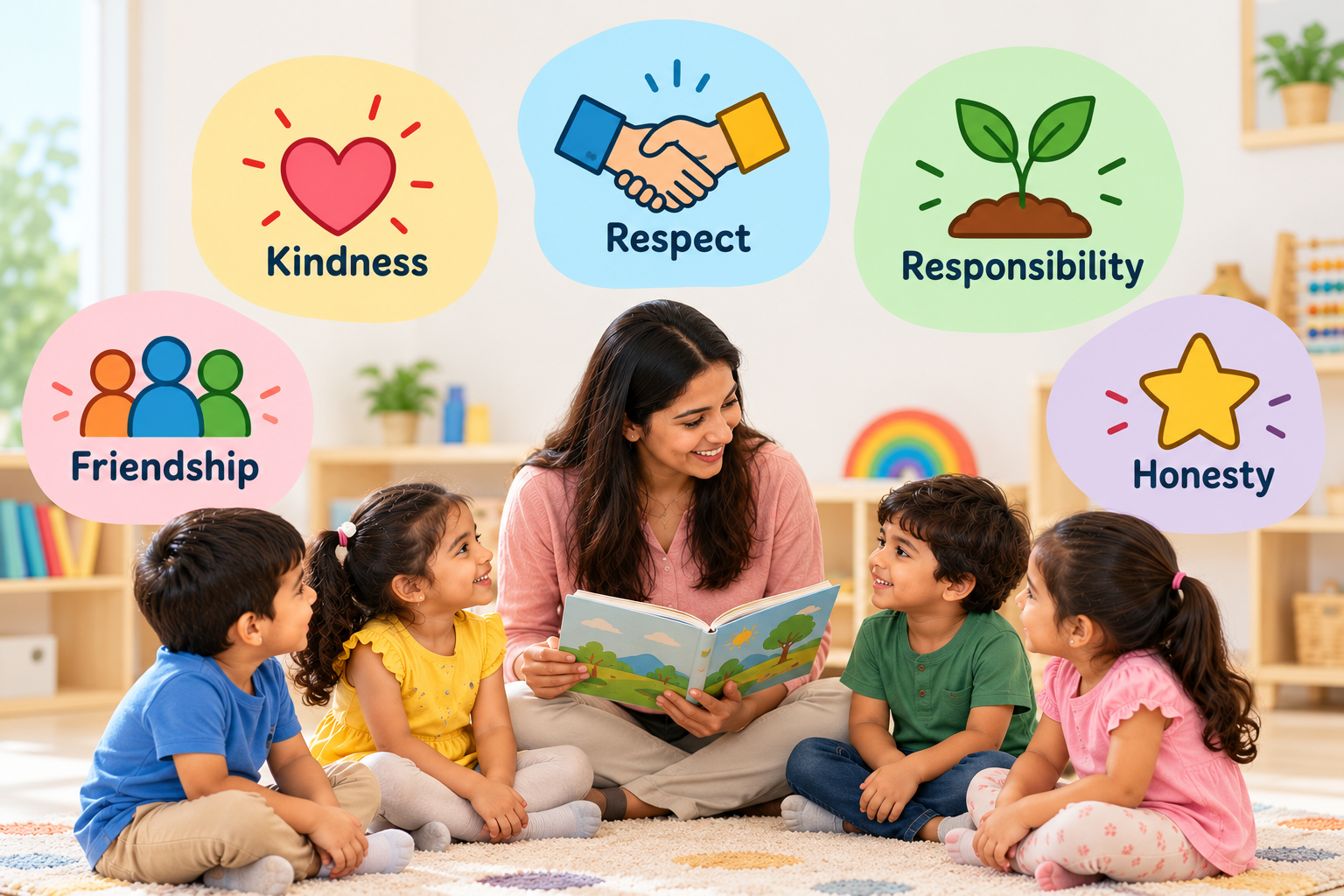
- Value education helps preschoolers understand and practise positive values such as honesty, kindness, respect, and empathy.
- Young children learn values by observing adults, participating in everyday routines, and experiencing relationships at home and school.
- It can support social-emotional development, independence, cooperation, and positive relationships in early childhood.
- Parents and teachers can introduce and reinforce values through stories, play, simple responsibilities, conversations, and everyday examples.
Early childhood is a time when children begin to understand how their actions affect themselves and others. Alongside cognitive, social, and emotional learning, value education can help children develop positive habits and healthy ways of interacting with people..
What Is Value Education?
Value education helps kids understand positive values and practise them in everyday situations. It’s not about memorising a list of rules, but more about experiencing how values apply in real life. For example, instead of simply telling a child that responsibility means taking care of their belongings, parents can encourage them to put their toys away after play.
What Is the Importance of Value Education for Preschoolers?
1. Supports Social & Emotional Development
Children need to understand their own feelings while also learning to recognise how others may feel. Everyday interactions help them practise social-emotional skills like empathy, cooperation, communication, and self-awareness.
2. Encourages Confidence & Independence
When children are given simple choices and age-appropriate responsibilities, they get more independent. For example, teaching them to clean up after playing or assigning them age-appropriate tasks can help raise an independent child.
3. Supports Positive Behaviour & Character
Encouraging honesty, kindness, respect, and consideration in everyday situations can contribute to their character development.
4. Teaches Children to Respect Differences
India is home to people from many communities, cultures, languages, and traditions. When kids interact with other children coming from different backgrounds, they need to respect their preferences, appearances, and experiences. Value education can introduce children to ideas such as respect, inclusion, and acceptance.
7 Core Values to Teach Young Children
- Honesty: Children can learn to tell the truth and acknowledge when they have made a mistake.
- Respect: Children can practise respect by listening to others, using polite words, and accepting that people may be different from them.
- Empathy: It’s important to teach children young that others can also feel hurt, so they need to think about how their actions may affect others.
- Kindness: Children can practise helping others, including someone in a game, or offering comfort when a friend is upset.
- Fairness: Children can learn fairness by taking turns, following simple rules, and allowing others to participate.
- Responsibility: A responsible child learns to care for their belongings and complete simple age-appropriate tasks.
- Cooperation: Children can learn to work and play with others, share materials, and contribute to group activities.
How to Teach Values to Children: 4 Simple Ways
Children learn values better through everyday experiences, stories, play, group activities, and by observing their parents and teachers.
1. Bring Values to Life Through Stories
Storytelling for kids is important as it helps them explore situations involving kindness, honesty, sharing, courage, and empathy. Ask them questions like “How do you think the character felt?” or “What could the character have done differently?” These help them absorb the moral lesson better.
Panchatantra stories for kids and other age-appropriate mythological stories can also be used where appropriate. The focus should remain on helping children understand the value behind the situation rather than simply memorising a moral.
2. Make Sharing & Turn-Taking Part of Play
Group activities teach children to share, cooperate, and be patient. Parents can encourage children to wait for their turn, share materials, and understand that other people also need an opportunity to play.
3. Give Children Small Responsibilities
Giving kids simple responsibilities at a young age teaches them that their contribution matters at home, while playing, and in the classroom. So, you can give them age-appropriate tasks such as carrying their plate to the kitchen, organising their books, or helping tidy the play area.
4. Talk About Feelings
When a child is upset or has a disagreement with another child, use the situation as an opportunity to talk about feelings.
Ask questions such as, “How do you think your friend felt when that happened?” This can help them connect their actions with other people’s feelings.
The Role of Parents & Teachers in Teaching Value Education to Preschoolers
Parents and preschool teachers play an important role because young children learn values by observing and experiencing them. What adults do often provides a stronger example than what they simply tell children to do.
- Model the Values: If adults speak respectfully, share, apologise after making a mistake, and help others, children get everyday examples of these behaviours.
- Keep Expectations Consistent: When possible, parents and teachers should have similar expectations around behaviours such as sharing, taking turns, speaking politely, and caring for belongings.
- Explain a Behaviour Calmly: Instead of relying only on punishment, explain why a behaviour matters. For example, you can say, “We take turns so everyone gets a chance to play.”
- Practise Values at Home: Encourage children to greet others politely, share with their siblings, help with simple household tasks, and respect people from different cultures and traditions.
- Praise Positive Behaviour: Instead of only saying, “Good boy” or “Good girl”, identify the value or behaviour you noticed. For example, say, “You shared your crayons with your friend. That was kind of you.”
Explore KLAY’s Foundational Development Programme, where play-based learning and meaningful experiences support your child’s holistic development and build a strong foundation for lifelong learning.







Subscribe to our newsletter
[contact-form-7 id="12706" title="Newsletter Form for post page"]Our Related Blogs
Yoga Benefits, Activities, and Poses for Preschoolers
For preschoolers, yoga isn’t about perfection but about giggles and benefits. So, are you curious how a simple stretch can support a child’s focus, flexibility, and emotional well-being? Let’s roll...
Year-End Reflection and Goal Setting for Children
Parenting is a journey filled with the brightest moments and valuable lessons, both for us and our children. As the year draws to a close, it’s the perfect time to...
Work-Life Balance Solutions for Parents in Emerald Hills Rd, Sector 65, Gurugram: The KLAY Daycare Advantage
Finding the perfect balance between professional commitments and parenting is a challenge for many working families in Gurugram. Parents in Emerald Hills Rd, Sector 65, especially, look for childcare solutions...