



 76767 08888



What Does Visual Perception Mean?
Visual perception refers to the brain’s ability to interpret and organise visual information. It’s how children make sense of what they see around them.
Many people confuse it with eyesight or vision clarity. However, the two are different.
Eyesight refers to how clearly the eyes see objects, while visual perception skills involve how the brain processes and understands those images.
For example, a child may be able to see letters clearly but may still struggle to recognise differences between similar letters such as “b” and “d”. This difficulty is related to visual perception, not eyesight.
Why Does Visual Perception Matter for Young Kids?
These skills help children interpret visual information and respond appropriately during daily activities and classroom learning.
When children have strong visual perception, they are better able to:
- Recognise letters and words while reading
- Copy shapes, drawings, and written letters
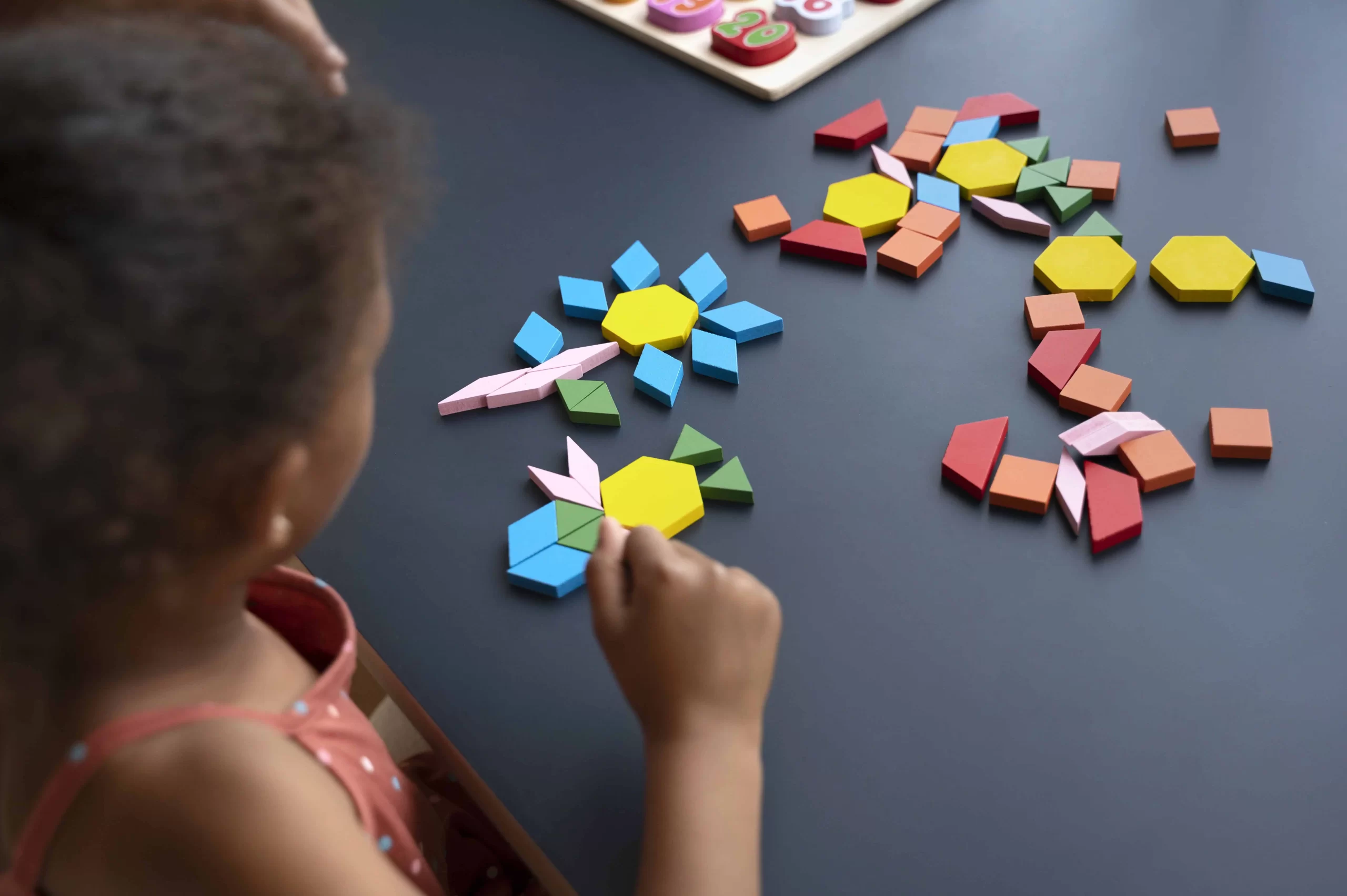
- Solve puzzles and pattern games
- Understand spatial directions such as left and right
- Improve their hand-eye coordination for drawing, colouring, and building.
Research in child development highlights that early visual processing abilities contribute to improved learning skills, cognitive development, academic readiness, and motor coordination in young children.
Core Skills That Build Visual Perception in Young Kids
- Sensory Processing: Sensory processing allows children to receive and interpret information using their senses, including sight, sound, touch, and movement.
- Visual-Spatial Relationships: This skill helps kids understand how objects relate to each other in space, such as identifying left, right, above, or below.
- Visual Attention: Visual attention enables a child to focus on relevant visual information while ignoring distractions.
- Visual Sequential Memory: This skill allows kids to remember visual patterns, sequences, or steps in the correct order.
- Visual Discrimination: Visual discrimination helps children notice differences and similarities between shapes, letters, colours, or patterns.
- Visual Figure-Ground Perception: This ability allows children to identify an object from a busy or cluttered background.
- Visual Form Constancy: This skill helps kids recognise objects, shapes, or letters even when they appear in different sizes, orientations, colours, or environments.
- Visual Memory: Visual memory allows children to recall information they have previously seen.
- Visual Closure: Visual closure helps children recognise objects even when only part of the object is visible.
How Does Visual Perception Support Growth & Development in Kids?
-
Learning & Academic Readiness
Strong visual perception skills help children recognise letters, shapes, and patterns. This ability allows them to identify differences between symbols, remember what they see, and connect visual information with sounds and meaning.
As a result, children find it easier to develop early reading and writing skills.
Related Read: Pre-Reading Skills & Activities for Preschoolers -
Coordination & Motor Development
Visual information guides how children move their bodies and hands.
When children see an object clearly and understand its position, their brain directs their movements to interact with it. This process supports tasks such as colouring inside lines, tracing shapes, stacking blocks, or catching a ball.
-
Spatial Understanding & Early Maths Skills
With well-developed visual perception skills, kids can better understand how objects relate to each other in space.
When children learn concepts such as above, below, inside, or beside, they develop spatial awareness. This ability supports puzzle-solving, sorting activities, and early mathematical thinking.
-
Independence in Everyday Activities
Children rely on their visual perception skills to recognise objects, organise belongings, and complete simple daily tasks.
For example, children use visual information to identify their shoes, match clothing items, or arrange toys in the correct place.
-
Focus & Visual Attention
With these skills, kids can develop the ability to focus on relevant visual information while ignoring distractions. This helps them follow classroom instructions, track words while reading, and complete activities that require concentration.
Signs That a Child May Be Struggling with Visual Perception
Identifying these early signs can help parents and teachers provide the right support.
Common indicators may include:
- Difficulty recognising letters or numbers
- Struggling to copy shapes or drawings
- Frequently losing their place while reading
- Difficulty identifying differences between similar objects
- Showing poor hand-eye coordination during activities like puzzles or colouring
- Having trouble organising written work on a page
- Avoiding visually demanding tasks such as reading or drawing.
If these signs appear consistently, it may be helpful to consult educators or developmental specialists for guidance.
How Can Parents Help Kids Develop Visual Perception Skills?
Play-based activities and learning experiences can provide many opportunities for children to practise interpreting visual information.
Here are some helpful visual perception activities you can try at home:
- Encourage children to complete puzzles, matching games, and sorting activities that require recognising patterns and shapes.
- Provide them with drawing, colouring, and building activities to strengthen hand-eye coordination.
- Play visual memory games where they observe objects and recall them later.
- Use everyday routines such as cooking or organising toys to help them recognise colours, shapes, and patterns.
- Engage children in sensory play activities such as sand play, water play, or textured materials.
These structured play experiences can significantly strengthen both visual learning and overall cognitive development.
How KLAY Supports Visual Perception Development in Preschoolers
At KLAY Preschools, learning environments are thoughtfully designed to nurture every aspect of early childhood development. Our curriculum blends structured activities with play-based learning experiences that help your child observe, explore, and understand the world around them.
Some ways we support visual perception development include:
- Well-Organised Learning Spaces: Our classrooms are designed to reduce visual clutter so that children can focus on learning materials and activities without distractions.
- Engaging Educational Activities: Our teachers incorporate age-appropriate fun and educational activities that strengthen observation, pattern recognition, and visual memory.
- Sensory-Based Learning Experiences: Hands-on exploration helps your child connect visual information with touch, movement, and sound.
- Visual Focus Activities: Activities such as puzzles, matching games, and picture recognition tasks strengthen attention and pattern recognition.
- Learning Through Real Environments: Our environment-based teaching encourages children to observe objects, shapes, colours, and patterns in everyday surroundings.
- Early Literacy Experiences: Visual learning also supports early reading development through picture books, storytelling, and structured literacy activities.
Conclusion
Developing strong visual perception skills is an essential part of early childhood learning. These abilities help children recognise patterns, interpret visual information, and build the foundation for reading, writing, and problem-solving.
Through engaging play, thoughtful activities, and supportive learning environments, parents and educators can nurture these skills naturally.
FAQs
-
What is visual perception in kids?
Visual perception refers to the brain’s ability to interpret and understand what the eyes see. It is different from having good eyesight, which refers to how clearly someone can see. A child may have normal eyesight but still experience difficulty with visual perception skills.
-
What are the signs that may indicate a child has problems with visual perception?
Some signs include difficulty with reading and writing, problems with mathematics, challenges with spatial awareness, poor hand-eye coordination, and difficulty concentrating on visual tasks.
-
Does ADHD affect visual perception?
Children with ADHD may experience certain functional vision challenges. However, ADHD does not necessarily cause structural alterations in the eyes.
-
How can you help a child with visual perception difficulties?
Parents and teachers can support children through helpful learning tools such as audiobooks, text-to-speech software, highlighted writing lines, graph paper for maths alignment, and structured classroom support.
-
How is visual perception disorder treated?
Vision therapy is a specialised approach that helps improve the brain-eye connection through structured exercises and activities. Occupational therapy may also support children in strengthening everyday learning skills.
-
What is the most common visual problem in children?
Refractive errors are the most common vision problems in children. Among them, the most common condition is myopia (nearsightedness), where children can see nearby objects clearly but struggle with distant vision.










Subscribe to our newsletter
[contact-form-7 id="12706" title="Newsletter Form for post page"]Our Related Blogs
Yoga Benefits, Activities, and Poses for Preschoolers
For preschoolers, yoga isn’t about perfection but about giggles and benefits. So, are you curious how a simple stretch can support a child’s focus, flexibility, and emotional well-being? Let’s roll...
Year-End Reflection and Goal Setting for Children
Parenting is a journey filled with the brightest moments and valuable lessons, both for us and our children. As the year draws to a close, it’s the perfect time to...
Work-Life Balance Solutions for Parents in Emerald Hills Rd, Sector 65, Gurugram: The KLAY Daycare Advantage
Finding the perfect balance between professional commitments and parenting is a challenge for many working families in Gurugram. Parents in Emerald Hills Rd, Sector 65, especially, look for childcare solutions...