



 76767 08888



Key Takeaways
- Mythological stories for kids help build strong moral values from an early age.
- These stories improve their imagination, language skills, and cultural understanding.
- They help children connect with traditions and heritage.
- Short stories make it easier for young children to understand complex ideas.
- Storytelling helps children learn life lessons in a simple and engaging way.
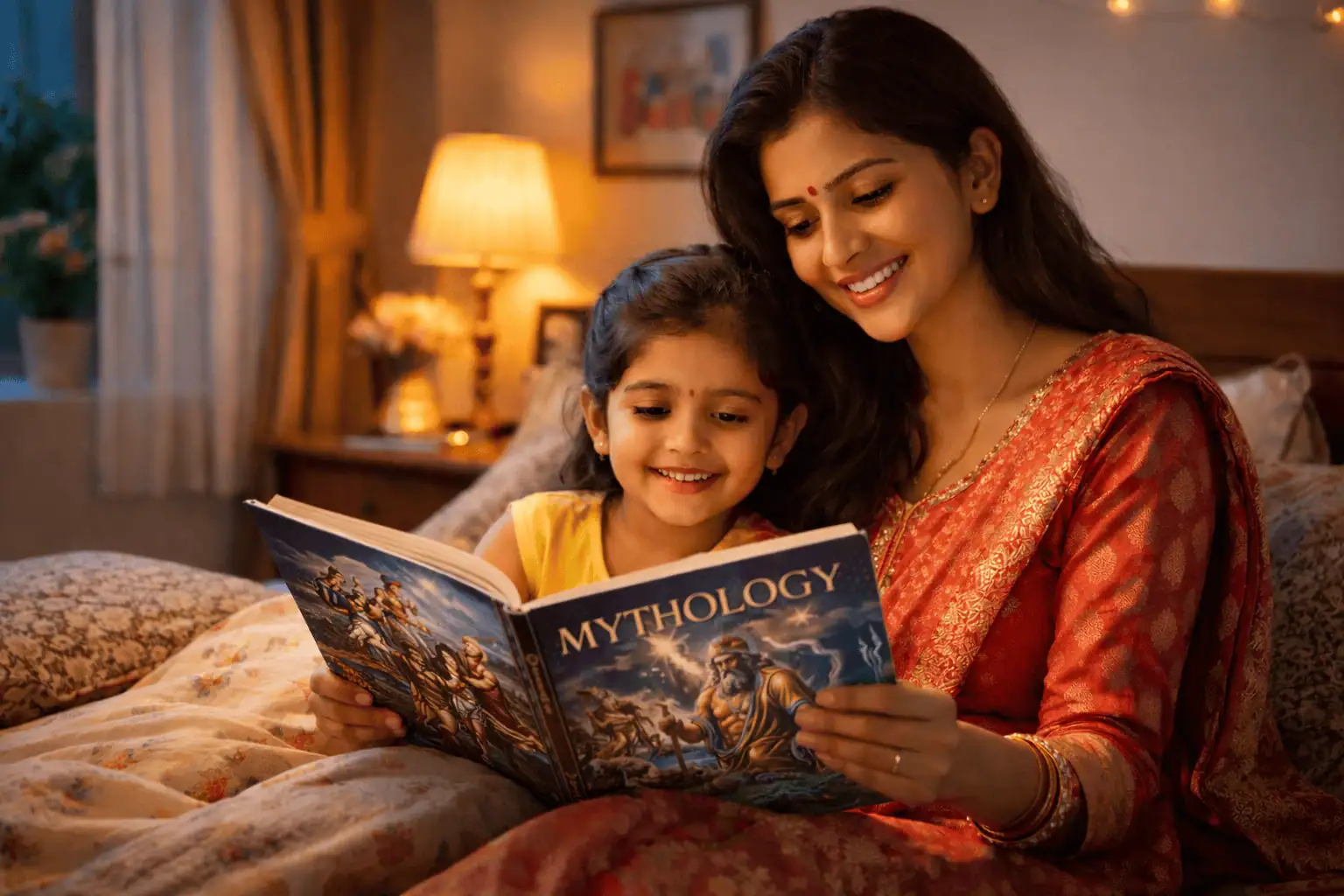
Mythological stories for kids are traditional tales that include Gods, Goddesses, heroes, and magical events. These stories have been passed down through generations and hold deep cultural and moral meaning. When shared in a child-friendly format, these not only entertain but also help them develop their imagination, understand the difference between right and wrong, and build a strong emotional and cultural foundation.
Many of these are also known as God stories for kids, since most mythological tales for children centre around Gods and Goddesses like Lord Ganesha, Lord Krishna, and Lord Hanuman. Whether you call them mythological stories, God stories, or Hindu mythology stories for kids, they all serve the same purpose: teaching timeless values through characters children can look up to.
How Mythological Stories Support a Child’s Growth
Mythology stories for kids can play an important role in shaping their thinking and behaviour in a natural and engaging way.
- Helps Children Learn Values Through Stories:Indian mythological stories for kids teach important values such as honesty, courage, kindness, and respect through relatable situations.
- Encourages Creativity & Imagination: These stories introduce magical worlds, divine characters, and exciting adventures that expand a child’s imagination.
- Builds Cultural Awareness & Identity: Listening to Hindu mythology stories helps children connect with Indian traditions, festivals, and cultural roots.
- Improves Language & Understanding: When read to kids in English, these stories also help them improve their vocabulary, comprehension, and communication skills.
Discover the benefits of storytelling for kids!
Read Now
Quick Reference: Short Mythological Stories for Kids at a Glance
Short on time? Here’s a one-line moral from each story before you dive into the full versions below.
| Story | Moral Lesson |
|---|---|
| The Birth of Lord Ganesha | Respect your parents and follow their guidance. |
| Hanuman & the Sun | Curiosity is important, but listening to elders helps us make better decisions. |
| Sita’s Agni Pariksha | Truth and honesty always shine through, even in difficult situations. |
| Krishna & Kaliya the Serpent | Courage and righteousness can overcome even the most dangerous challenges. |
| The Frog Prince: A Tale from the Puranas | Kindness and selfless actions are always rewarded. |
| Krishna Lifts the Govardhan Hill | Protecting others and standing up for what is right is a true sign of leadership. |
| The Churning of the Ocean | Teamwork and patience help achieve great results, even in difficult situations. |
| Bhima & Hidimba | True strength lies in courage combined with fairness and respect for others. |
| The Curse of Nal & Damayanti | Patience, faith, and trust can help overcome even the toughest challenges. |
| The Birth of Krishna: Story of Devaki & Vasudeva | Hope and goodness can overcome even the darkest situations. |
10 Popular Indian Mythological Stories for Kids with Moral Lessons
While the benefits of mythological stories are plenty, here are the top 10 most popular short stories with valuable moral lessons:
-
The Birth of Lord Ganesha
Goddess Parvati created a young boy named Ganesha. She asked him to guard the door while she bathed and not allow anyone to enter. When Lord Shiva returned home, Ganesha stopped him, as he did not know who he was. Lord Shiva was angry and cut off Ganesha’s head. When Parvati saw this, she was heartbroken and demanded that her son be brought back to life.
To calm her, Shiva placed an elephant’s head on Ganesha’s body and revived him. He also blessed Ganesha and declared that he would be worshipped first before any new beginning.
Moral: Respect your parents and follow their guidance, as Ganesha obeyed his mother without question.
-
Hanuman & the Sun
As a young child, Lord Hanuman was full of energy and curiosity. One morning, he saw the bright rising sun in the sky and thought it was a ripe fruit. Without thinking twice, he jumped high into the sky to catch it. Seeing this, the gods were worried, as Hanuman’s strength was immense. Indra struck him with his thunderbolt to stop him, which caused Hanuman to fall back to earth.
Later, Hanuman learned that curiosity should be guided by wisdom. He also realised the importance of listening to elders and understanding situations before acting.
Moral: Curiosity is important for learning, but listening to elders helps us make better decisions.
-
Sita’s Agni Pariksha
After Lord Rama rescued Sita from Lanka, some people questioned her purity because she had lived in Ravana’s palace. Although Rama trusted Sita, he wanted to prove her innocence to the world.
To show her truth and devotion, Sita agreed to undergo the agni pariksha, or trial by fire. She stepped into the flames with complete faith and emerged unharmed, proving her purity. This moment showed her strength, dignity, and unwavering belief in truth. It also reminded everyone that truth does not need to hide.
Moral: Truth and honesty always shine through, even in difficult situations.
-
Krishna & Kaliya the Serpent
The river Yamuna had become poisonous because of a dangerous serpent named Kaliya. The villagers were scared, and even animals could not go near the water.
Young Krishna decided to help. He jumped into the river and faced the mighty serpent. After a fierce struggle, Krishna climbed onto Kaliya’s many heads and danced on them, forcing the serpent to surrender. Kaliya realised his mistake and promised to leave the river forever. Krishna saved the villagers and restored peace.
Moral: Courage and righteousness can overcome even the most dangerous challenges.
-
The Frog Prince: A Tale from the Puranas
Once, a kind-hearted frog lived near a pond and always helped other creatures. It shared food, warned others of danger, and never expected anything in return.
One day, a sage noticed the frog’s kindness and blessed it. Because of its good deeds, the frog was rewarded with a better life and happiness. The story shows that even the smallest acts of kindness can make a big difference. Good actions always come back in some form.
Moral: Kindness and selfless actions are always rewarded.
-
Krishna Lifts the Govardhan Hill
The villagers of Vrindavan used to pray to Lord Indra for rain. Krishna explained that they should instead respect nature and worship Govardhan Hill, which provided them with food and shelter.
This angered Indra, who sent heavy rains and storms to punish the villagers. Seeing their fear, Krishna lifted the entire Govardhan Hill on his little finger and sheltered everyone underneath. After several days, Lord Indra realised his mistake and stopped the storm. The villagers were safe because of Krishna’s bravery and care.
Moral: Protecting others and standing up for what is right is a true sign of leadership.
-
The Churning of the Ocean
The gods and demons wanted to obtain the nectar of immortality, so they decided to churn the ocean together. They used a mountain as a rod and a serpent as a rope to begin the process.
The task was difficult and required great effort from both sides. Many things emerged from the ocean during the churning, including poison and precious treasures. Finally, the nectar appeared, showing that their hard work had paid off. Even though they were rivals, their teamwork made success possible.
Moral: Teamwork and patience help achieve great results, even in difficult situations.
-
Bhima & Hidimba
During their exile, Bhima and his brothers entered a forest where a demon named Hidimb lived. He sent his demoness sister Hidimba to capture them, but when she met Bhima, she was impressed by his strength and kindness.
Instead of harming him, Hidimba chose to help Bhima and warned him about her brother’s plan. Bhima bravely fought Hidimb and defeated him to protect his family. Bhima later treated Hidimba with respect and fairness, showing that courage should always be guided by kindness.
Moral: True strength lies in courage combined with fairness and respect for others.
-
The Curse of Nal & Damayanti
Nal and Damayanti loved each other deeply and got married. However, due to a curse and bad luck, King Nal lost his kingdom and was separated from Damayanti. They faced many hardships and lived apart for a long time. Despite the challenges, both of them remained patient and continued to believe in each other.
In the end, their faith and perseverance helped them reunite and rebuild their life together.
Moral: Patience, faith, and trust can help overcome even the toughest challenges.
-
The Birth of Krishna: Story of Devaki & Vasudeva
Lord Krishna was born to Devaki and Vasudeva in a prison, as Devaki’s brother, the evil king Kansa, feared that Krishna would defeat him. On the night Krishna was born, Vasudeva secretly carried him across the river to safety.
Krishna grew up in a village, spreading joy and protecting people from harm. Even as a child, he showed courage and wisdom by defeating evil forces. Despite the difficult circumstances of his birth, Krishna became a symbol of hope, goodness, and strength.
Moral: Hope and goodness can overcome even the darkest situations.
Read Now
How to Make Mythological Stories Fun for Kids
Mythological stories for kids can benefit them only when they can comprehend the meaning behind each story. Here’s how you can present them in a way that is simple, interactive, and enjoyable for young minds:
-
Use Simple & Age-Appropriate Language
Young children understand stories better when the language is clear and easy.
- Use short and simple sentences that match your child’s age and understanding.
- Avoid difficult words or complex explanations that may confuse them.
- Explain unfamiliar words or concepts in a simple manner.
- Repeat key parts of the story to help children remember and understand better.
-
Pick Short & Interesting Stories
Children have a short attention span, so stories need to be engaging from start to finish.
- Choose short mythological stories that are meant for kids, as they are easy to follow.
- Focus on one main idea or lesson in each story.
- Avoid adding too many details that may make the story difficult to understand.
- End the story with a clear moral so children can connect with it easily.
-
Be Expressive & Use Voice Modulation
The way you tell a story can make a big difference in how children respond to it.
- To keep things interesting, change your voice for different characters.
- Use facial expressions and hand gestures while narrating.
- Add excitement, surprise, or softness depending on the scene.
- Pause at the right moments to build curiosity and interest.
-
Ask Questions to Involve the Child
Involving children during storytelling helps improve their thinking and engagement.
- Ask simple questions like, “What do you think will happen next?”
- Encourage them to share their thoughts and opinions about the story.
- Discuss the moral and ask how they would act in a similar situation.
- Let children relate the story to their own daily experiences.
-
Use Visual Aids for Better Understanding
Visuals help children imagine characters and scenes more clearly.
- Show pictures of characters while telling the story.
- Use illustrated storybooks to make storytelling more engaging.
- Try puppet shows or simple role play to bring stories to life.
- Encourage children to draw scenes from the story to improve recall.
-
Use Digital & Audio Resources
Modern tools can make storytelling more interactive and accessible.
- Play child-friendly podcasts that narrate mythological stories for kids in English.
- Use animated videos to explain stories in a fun and visual way.
- Choose content that is age-appropriate and easy to understand.
- Balance screen time with live storytelling for better learning.
How KLAY Preschools Make Storytelling Meaningful for Young Learners
At KLAY Preschools, storytelling is not just a classroom activity. It is a powerful way to help children learn, express, and grow with confidence.
Instead of simply listening, children actively engage with stories in ways that feel natural and enjoyable:
- Interactive storytelling sessions encourage children to ask questions, share ideas, and think creatively.
- Role play and group activities help children bring stories to life and understand different perspectives.
- Play-based learning methods ensure that children learn through exploration, not memorisation.
- Emotional learning through stories helps children understand feelings like kindness, empathy, and courage.
With a safe environment, low teacher-child ratios, and well-designed learning spaces, children feel comfortable expressing themselves and building confidence every day.
FAQs
-
What are mythological stories?
Mythological stories for kids are traditional stories about gods, heroes, and magical events that teach values and lessons.
-
Which mythological stories are best for children?
Simple stories from the Ramayana, Mahabharata, and the tales of Lord Krishna and Lord Ganesha are ideal for children.
-
What do children learn from these stories?
Children learn moral values like honesty, courage, kindness, and respect.
-
What is the right age to introduce mythology?
Children can start listening to small mythological stories for kids from around 4 years of age.
-
Are mythological stories real?
Mythological stories are rooted in cultural beliefs and traditions. They are valued for their lessons and meanings.
-
Are these mythological stories available in English?
Yes, all the mythological stories for kids on this page are written in simple, easy-to-read English, making them ideal for reading aloud or for early readers.
-
What are some good Indian mythological stories for kids?
Popular Indian mythological stories for kids include the birth of Lord Ganesha, Hanuman and the Sun, Krishna and Kaliya the Serpent, and Krishna lifting the Govardhan Hill — all featured above with their moral lessons.
-
What are some Hindu mythological stories for kids?
Hindu mythological stories for kids often feature deities like Ganesha, Krishna, Hanuman, and Shiva. These stories, drawn from texts like the Ramayana and Mahabharata, teach children values such as courage, honesty, and respect.












Subscribe to our newsletter
[contact-form-7 id="12706" title="Newsletter Form for post page"]Our Related Blogs
Yoga Benefits, Activities, and Poses for Preschoolers
For preschoolers, yoga isn’t about perfection but about giggles and benefits. So, are you curious how a simple stretch can support a child’s focus, flexibility, and emotional well-being? Let’s roll...
Year-End Reflection and Goal Setting for Children
Parenting is a journey filled with the brightest moments and valuable lessons, both for us and our children. As the year draws to a close, it’s the perfect time to...
Work-Life Balance Solutions for Parents in Emerald Hills Rd, Sector 65, Gurugram: The KLAY Daycare Advantage
Finding the perfect balance between professional commitments and parenting is a challenge for many working families in Gurugram. Parents in Emerald Hills Rd, Sector 65, especially, look for childcare solutions...