



 76767 08888


Whether it’s a sweltering summer day, a chilly winter morning, or a rainy afternoon, there are times when stepping outside just isn’t an option. Yet, for a child, the desire to play and explore doesn’t fade with the weather. With the right indoor activities, as parents, we can transform these moments into opportunities for growth, helping our children stay active, entertained, and healthy despite the gloomy weather outside. Indoor games offer a world of fun and excitement, no matter the season. These games not only keep them entertained but also promote physical fitness and mental agility, making them a perfect alternative for days when the weather isn’t cooperating. Here is the list of indoor games and activities for preschool kids.
20 Fun-Filled Indoor Activities & Games for Preschoolers:
Let’s see the list of some of the best indoor games that are not just rescues to a rainy day but also help children in a great manner:
1. Indoor Hopscotch
⭐ Best for: Ages 3–6 | Skills: Balance, coordination, number recognition

Use colourful masking tape to create a hopscotch grid on your living room or hallway floor. Number the squares and let your child hop from one to the next — just like the outdoor version, but safe for monsoon days indoors. As they jump and land, they practise balance, gross motor control, and number recognition. For older preschoolers (4–6), add a small challenge to each square — clap twice, say an animal name, or spin before hopping forward. Masking tape peels off easily without marking the floor.
Works perfectly in apartment corridors — the long, narrow space is actually ideal for hopscotch. Marble or tiled floors (common in Indian apartments) are fine as long as your child is barefoot or in anti-slip socks. The tape is easy to lay out and peel off in minutes, so it doesn’t permanently claim the hallway.
Set this up before your morning calls and let your child play independently. The numbered squares give them a self-directed activity — they don’t need you to manage each hop. Most 4–6 year olds will repeat the course 10–15 times before losing interest, which easily covers a 30-minute meeting.
2. Indoor Obstacle Course
⭐ Best for: Ages 3–6 | Skills: Motor skills, problem-solving, confidence

Transform your living room into an adventure zone using sofa cushions to jump over, a blanket draped over chairs to crawl through, a row of books to tiptoe around, and a yoga mat as the finish line. Change the layout every time to keep things fresh. Obstacle courses require children to plan movements, adapt when something doesn’t work, and persist through a challenge — all deeply developmental for a preschooler.
Indian homes are full of perfect obstacle course materials — a rolled-up chatai makes a great balance beam, steel plates laid flat become stepping stones, and sofa bolster cushions are ideal hurdles. No need to buy anything special. The setup takes under five minutes and the variety keeps children engaged far longer than a single toy would.
This is one of the best WFH-day activities because once set up, children run the course independently and repetitively. If you have a helper at home, ask them to be the ‘timer’ — children will focus completely on beating their own score and won’t need your attention for a solid stretch.
3. Hula Hooping
⭐ Best for: Ages 3–6 | Skills: Coordination, rhythm, core strength

Put on some upbeat music and get your child spinning. Even if they can’t keep the hoop going yet — and most preschoolers can’t — the act of trying, swaying, and laughing is brilliant physical activity. For younger preschoolers (2–4 years), use the hoop on the floor as a target to jump into, step around, or toss a soft ball through. For older ones, introduce friendly challenges — who can hula hoop the longest, or can you hoop while singing a rhyme?
Hula hoops are available at most toy shops in metro cities for under ₹200 and are one of the best value indoor activity investments for this age group. In a small apartment, push the coffee table aside and even a modest living room has enough space. Playing Bollywood kids’ songs or popular nursery rhyme playlists in the background turns this into an instant dance party.
Play a favourite playlist and let your child hula hoop freely while you take a call in the next room. The music acts as a natural timer — when the playlist ends, the activity wraps up organically. No supervision needed for children aged 4 and above.
4. Simon Says
⭐ Best for: Ages 3–6 | Skills: Listening, self-regulation, physical fitness

Give commands starting with ‘Simon says’ and watch your child follow — but the moment you drop ‘Simon says,’ anyone who still follows is out. Keep commands physical and fun — ‘Simon says hop on one foot,’ ‘Simon says touch your nose and spin,’ ‘Simon says pretend you’re a sleeping lion.’ The self-control required to not act when the phrase is missing is a genuine executive function exercise — the same skill that supports focus in school.
This is an outstanding activity for grandparents visiting during summer holidays or Diwali break. Nana or Dadi can lead Simon Says from a chair without any physical exertion — they just need their voice and enthusiasm. Children light up when grandparents play with them, and the intergenerational connection makes the activity richer for everyone.
If you need 15–20 minutes of quiet, brief a grandparent or helper to lead a round of Simon Says. The game naturally maintains its own energy without adult micromanagement and works well even in a single room.
5. Scavenger Hunt / Treasure Hunt
⭐ Best for: Ages 3–6 | Skills: Problem-solving, critical thinking, language

Hide simple objects around your home and give your child picture cards (for non-readers) or written clues (for older preschoolers) to find them. Use riddles: ‘Look where the cold things live’ leads to the fridge; ‘Find where you wash your hands’ leads to the bathroom. End with a small reward — a sticker, a favourite snack, or a new crayon. The hunt can be themed around colours, animals, or shapes to layer in learning.
Themed treasure hunts around Indian festivals work brilliantly — a Diwali hunt where each clue leads to a small diya or sweet, or a Holi hunt with colour-coded clues. Summer holidays and long vacation weeks are ideal for multi-day hunts where each day reveals the next clue. These create rituals children look forward to and talk about long after.
Set up the clue trail the night before or during your child’s nap. Once the hunt is live, children aged 4 and above follow clues independently for 30–45 minutes without needing you to guide each step. It’s one of the highest-ROI activities for a busy WFH day — maximum engagement for minimal real-time effort from you.
6. Giant Floor Game Board
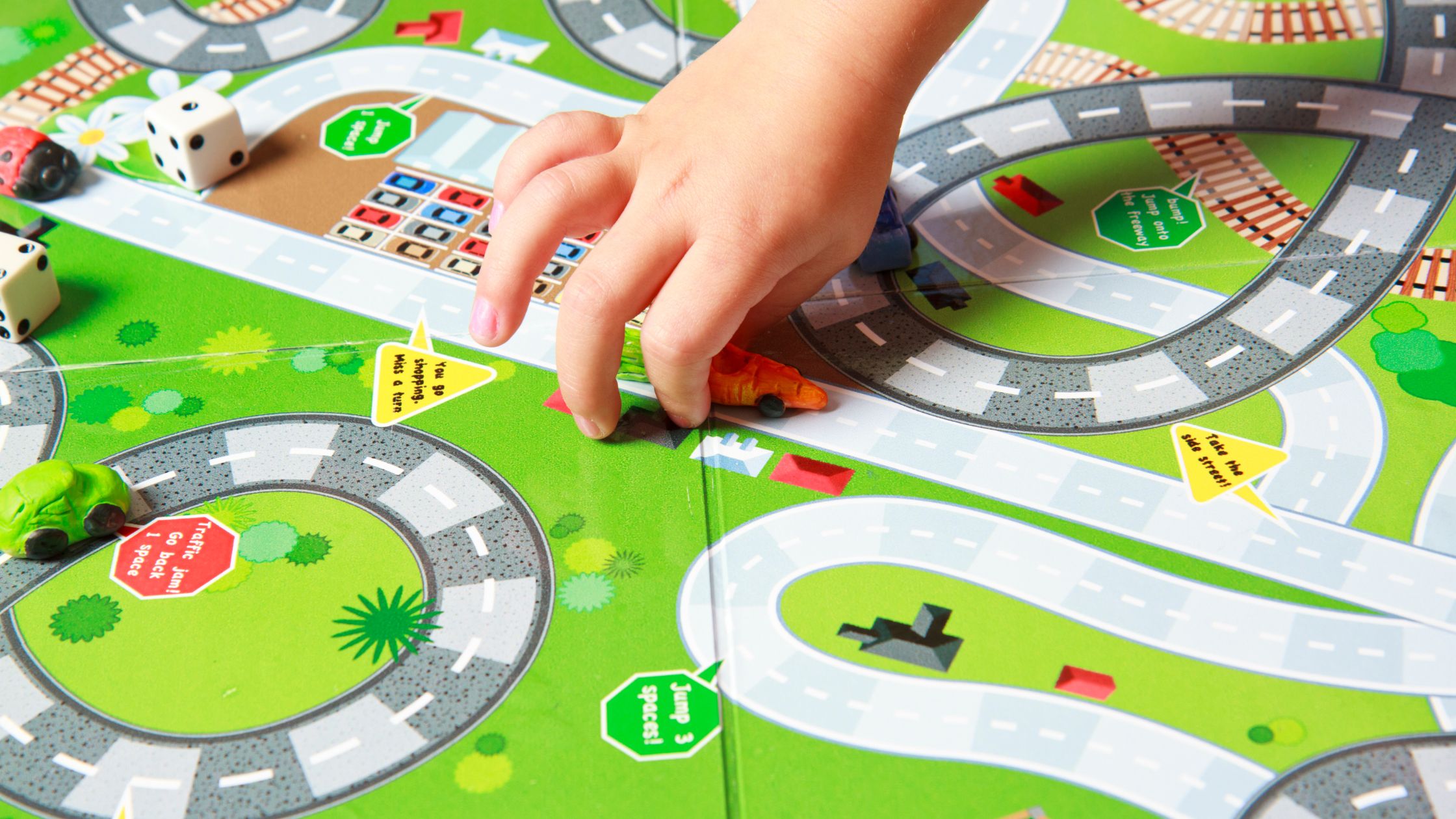
⭐ Best for: Ages 4–6 | Skills: Number recognition, turn-taking, decision-making
Use coloured paper squares and tape to create a large game board on your floor — a life-sized Snakes and Ladders or a custom path game. Children become the game pieces, moving forward based on dice rolls. Add activity squares — land on yellow and do five star jumps, land on blue and name three animals. This turns a passive board game into an active, physical, and cognitive experience simultaneously.
This setup works particularly well in Indian homes with large open floor areas or a cleared bedroom. Use old newspapers or colour printouts for the squares — no art supplies needed. Once laid out, the board can stay on the floor for several days and be played repeatedly, making it ideal for stretches like Diwali vacation or the 10-day Dussehra break when children are home for extended periods.
Once the board is set up (takes about 10 minutes), children aged 4+ can play with a sibling, a cousin visiting for holidays, or even a grandparent rolling the dice from a chair. Minimal active supervision needed — the board structure manages the activity itself.
7. Tag Team Puzzles
⭐ Best for: Ages 4–6 | Skills: Teamwork, patience, strategic thinking
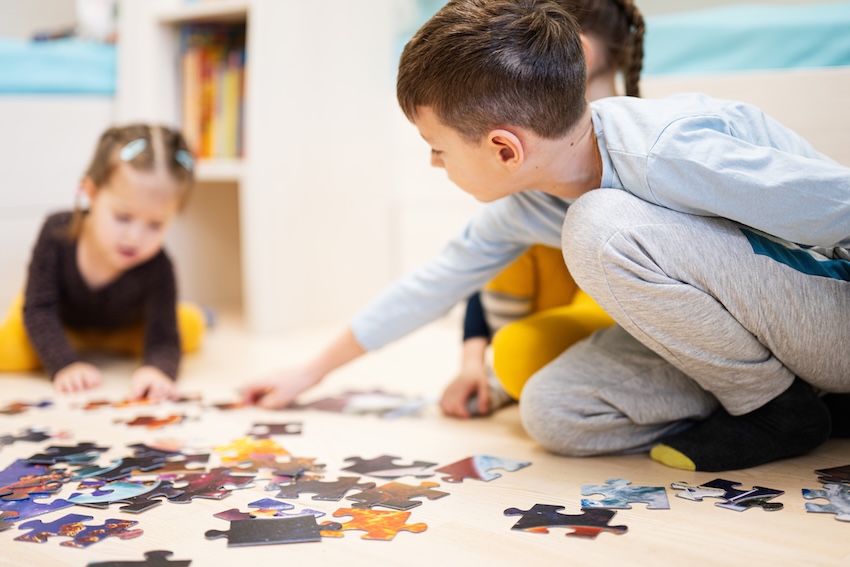
Have two or more children work on a single puzzle together — but only one person can touch a piece at a time. When they place a piece or give up on finding the right one, they tag the next player. This cooperative format teaches patience and turn-taking in a way that feels exciting rather than forced. For younger preschoolers, use a 12–24 piece puzzle; for older ones, a 48–60 piece puzzle themed around something they love.
Good quality puzzles are widely available on Amazon India and in toy stores across metro cities — brands like Funskool and Frank offer age-appropriate options at reasonable price points. A single puzzle can be used for Tag Team play, solo play, and timed challenges across multiple days, making it excellent value. Works particularly well during monsoon weeks when outdoor play is completely off the table.
Puzzles are one of the best independent-play activities for WFH days — children as young as 3.5 can work on a simple puzzle alone for 15–20 minutes. Leave the puzzle on a low table in your work-from-home setup’s line of sight so you can glance over without interrupting your call.
8. Animal Walks
⭐ Best for: Ages 2–5 | Skills: Gross motor skills, body awareness, imagination
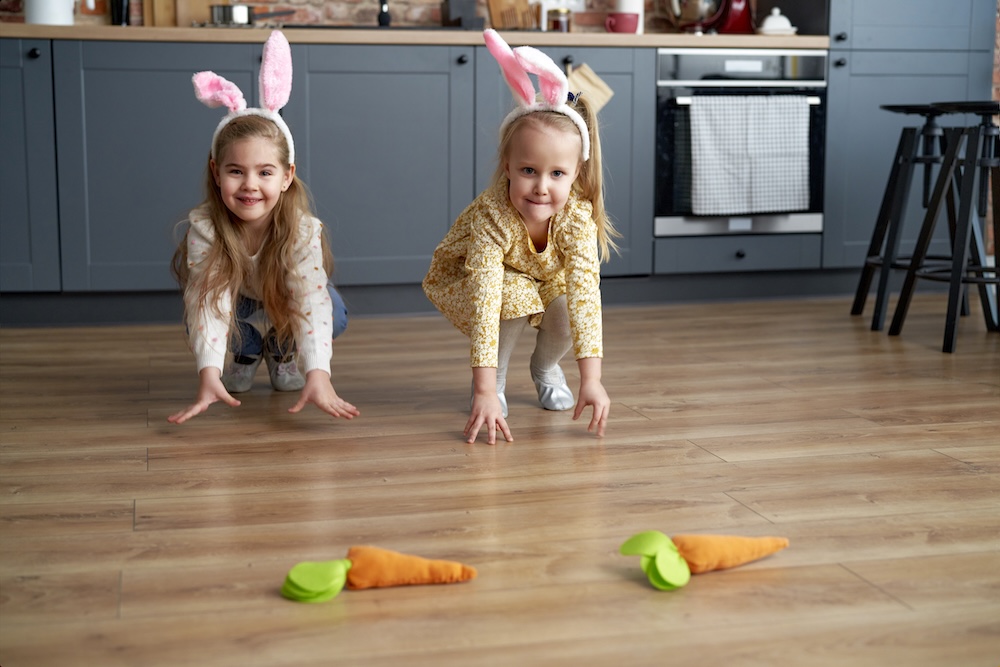
Call out an animal and let your child move like one — waddle like a penguin, stomp like an elephant, slither like a snake, leap like a frog, tiptoe like a cat. String them into a story: ‘We’re going on a jungle safari — first we spot a lion, then we tiptoe past a sleeping snake.’ Even five minutes of animal walks will noticeably reduce a restless preschooler’s energy and improve their mood.
Pair this with a visit to the local library or a picture book borrowed from school about Indian animals — tigers, peacocks, elephants, monkeys. Asking ‘how does a peacock walk?’ after reading about one creates a lovely connection between story and movement. For children who’ve visited a zoo recently, re-enacting animals they saw makes this deeply personal and memorable.
This is a brilliant between-calls reset for a restless preschooler. A five-minute animal walk routine mid-morning — even if you run it quickly before jumping back to your laptop — dramatically improves a child’s ability to settle into quieter independent play afterwards. Think of it as a pressure-release valve.
9. Balloon Volleyball
⭐ Best for: Ages 3–6 | Skills: Hand-eye coordination, reflexes, social play
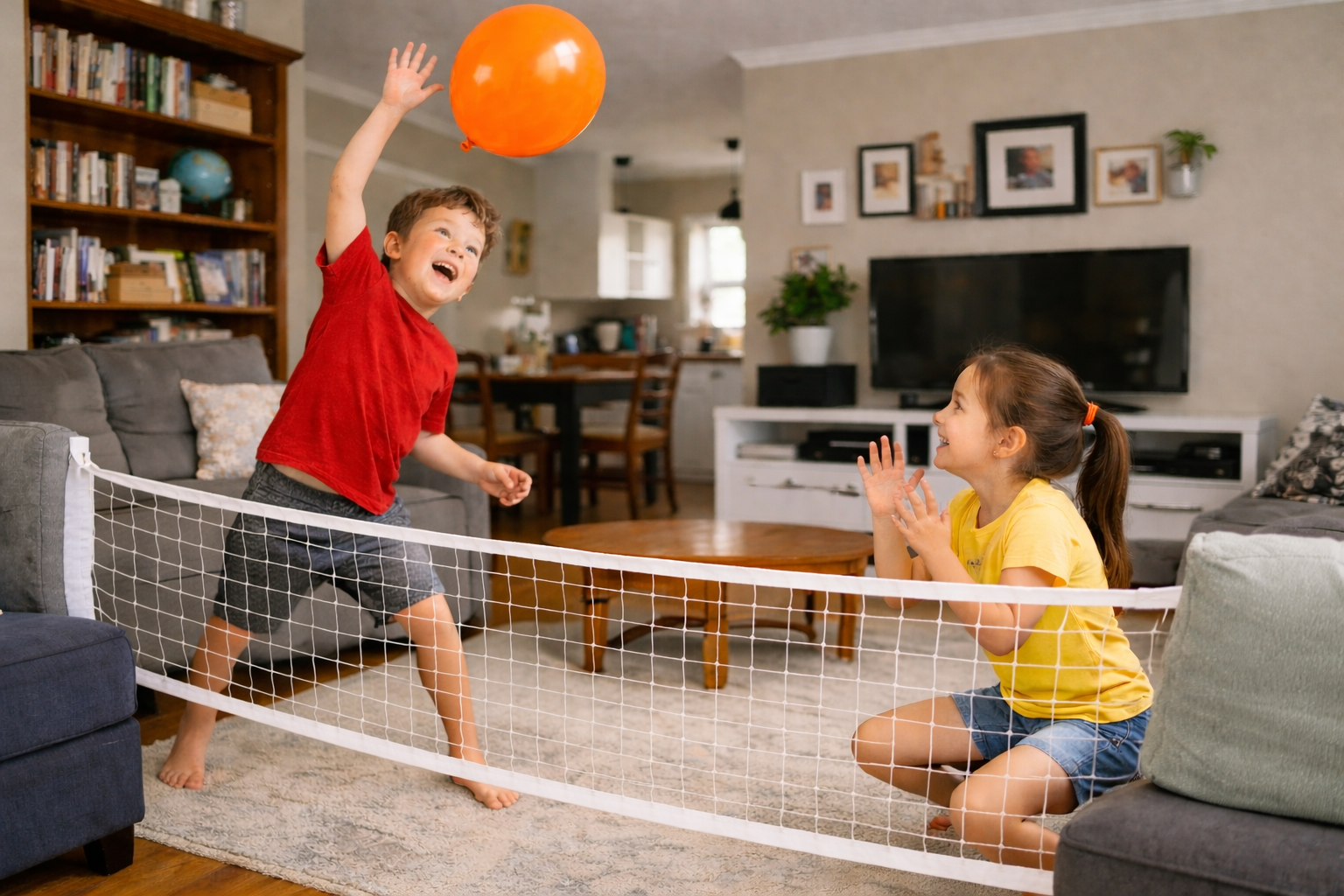
Tie a piece of string between two chairs to create a net and use an inflated balloon as the ball. The rules are simple — don’t let the balloon touch the ground on your side. A balloon moves slowly enough that even a 3-year-old can track and respond to it, making it perfect for this age group. It also removes any fear of injury or breakage, so children play freely in any room without worry.
Balloons cost almost nothing and are available at every general store and supermarket across India. Keep a small stock at home — they’re one of the most versatile low-cost play items for preschoolers. In a 2BHK apartment, push the sofa back and even the living room has enough space. The string-net setup takes under two minutes.
Balloon volleyball is one of the few activities that children aged 3–6 can play with minimal adult involvement — the balloon’s slow movement means they don’t need you to correct or guide each shot. Set it up, point them to it, and step back to your work. Works well for children playing solo (keep-up challenge) or with a sibling or the household helper.
10. Indoor Camping
⭐ Best for: Ages 3–6 | Skills: Storytelling, imagination, cooperation
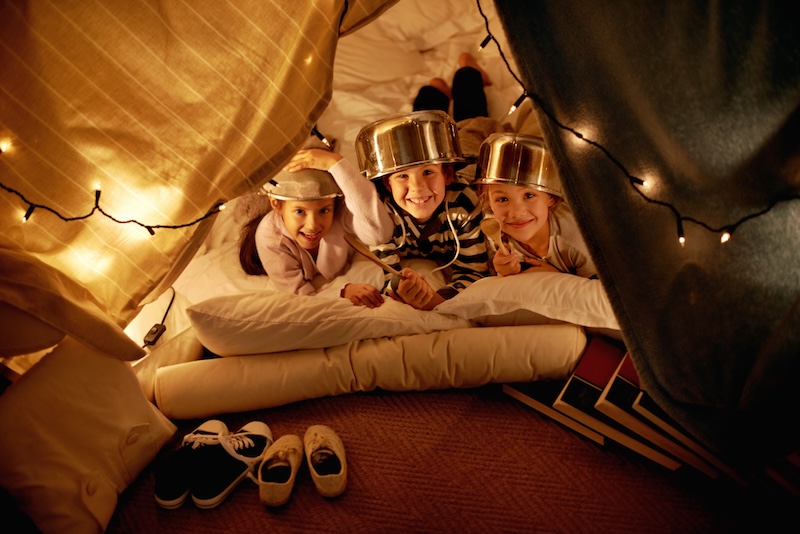
Set up a campsite in your living room using bedsheets, cushions, fairy lights, and sleeping bags or quilts. Create a pretend campfire with crumpled orange and yellow paper. Gather around it for stories, pretend marshmallow roasting, and quiet reading. This is especially lovely on monsoon evenings when rain is pouring outside — it creates a warm, cozy ritual children remember and ask to repeat for weeks.
This is a natural grandparent activity. Nana or Thatha sitting by the ‘campfire’ telling stories from their own childhood — or folk tales they remember — creates one of the richest play experiences a preschooler can have. No preparation needed from a grandparent: just a comfortable spot and their voice. If grandparents aren’t in town, a voice call with them during indoor camping can work beautifully too.
Set up the indoor camp during nap time or early morning. By evening, it’s ready and your child can go straight in after dinner. The contained, cozy setup naturally keeps children settled and quiet — ideal for winding down after an active WFH day without resorting to screens before bed.
11. Freeze Dance
⭐ Best for: Ages 2–5 | Skills: Listening, self-regulation, body control
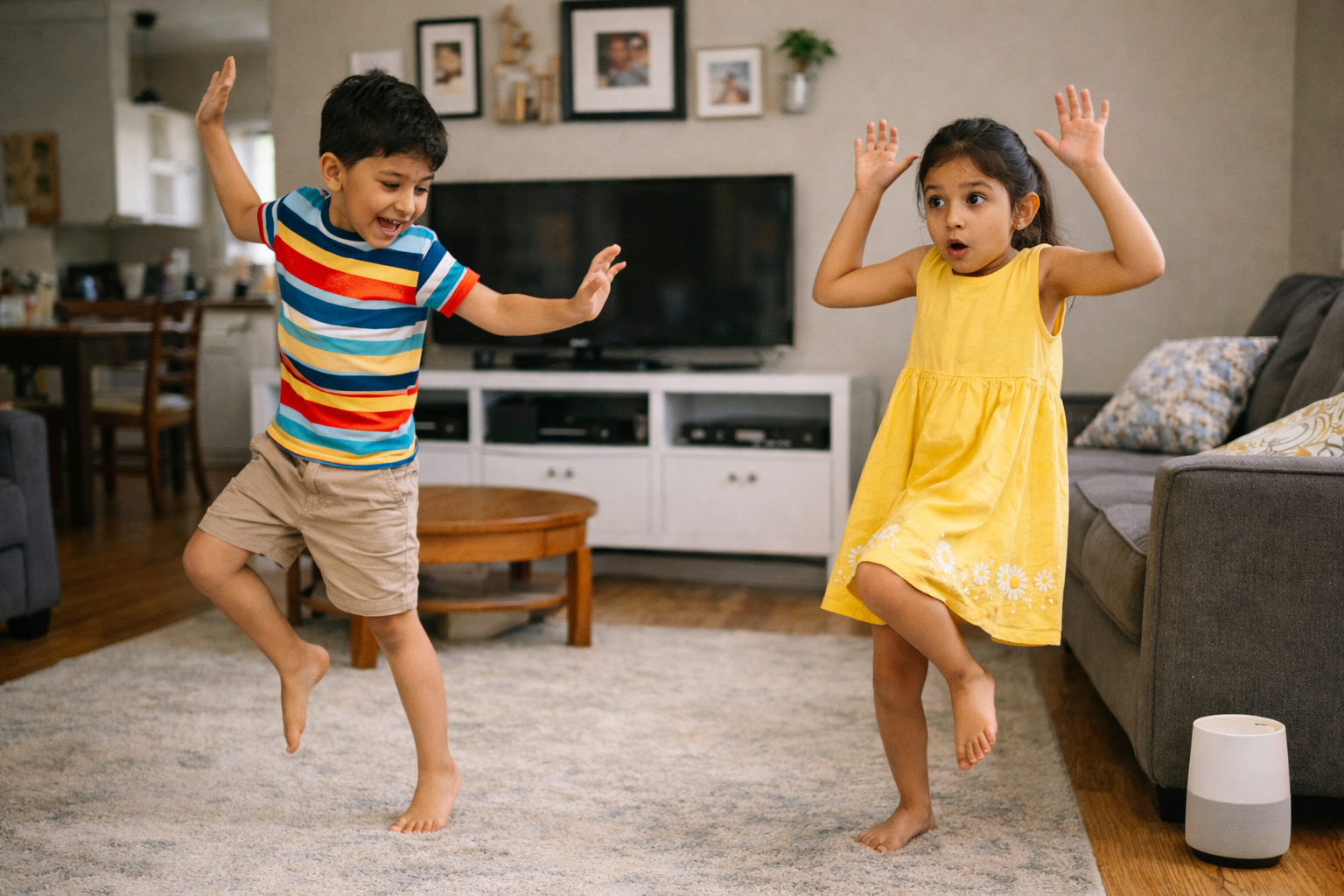
Play music and let your child dance freely — the moment the music stops, they must freeze completely still. Resume the music and they dance again. For a preschooler, the discipline of stopping mid-movement is a genuine challenge and a genuinely fun one. Use a mix of fast and slow music to vary the energy level. Freeze Dance is one of those rare activities that is simultaneously high-energy and develops self-regulation — a foundational school-readiness skill.
Indian kids’ music playlists on Spotify and YouTube — nursery rhymes, Bollywood kids’ songs, or even classic Doordarshan jingles that grandparents remember fondly — work perfectly. The familiar tunes add a layer of joy that generic music doesn’t. For solo play, children can control the music themselves using a simple smart speaker with a voice command, making this surprisingly independent for children aged 4+.
Freeze Dance is excellent for the WFH witching hour — usually 4 to 5 pm when your child’s energy peaks and your own patience is lowest. A 15-minute freeze dance session (child runs it, you set up the playlist) burns enough energy to get you through dinner preparation without a meltdown.
12. Group Art / Collaborative Mural
⭐ Best for: Ages 2–6 | Skills: Creativity, self-expression, cooperation
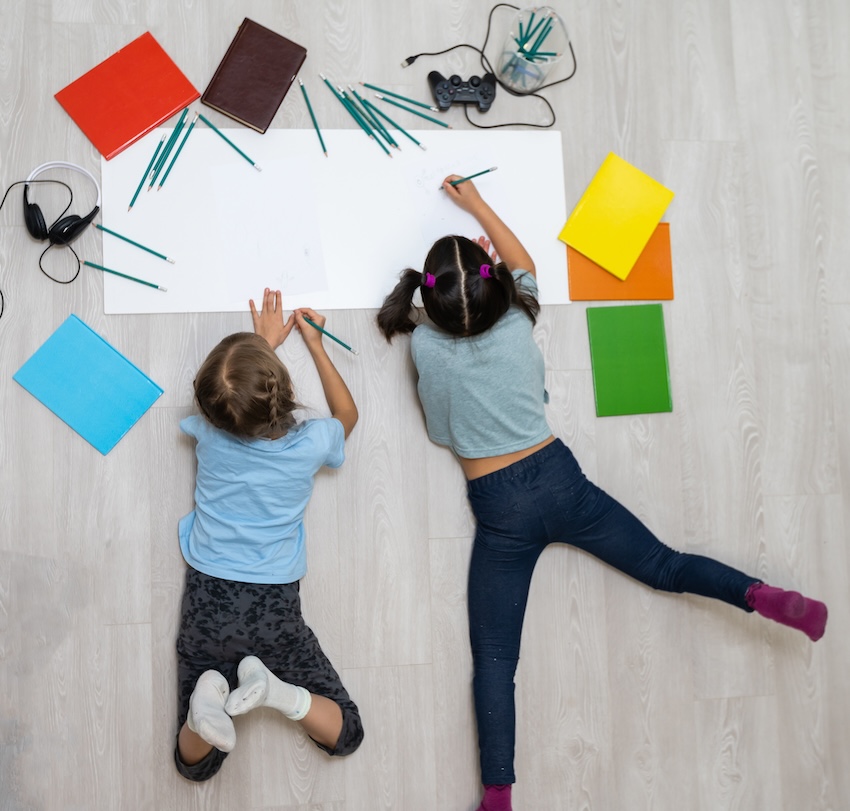
Tape together several A4 sheets or use a roll of chart paper on the floor and give everyone — children, parents, grandparents — their own section to fill with whatever they like. Give it a theme: ‘Draw your favourite place in India,’ or ‘What does our city look like?’ Display the finished mural on a wall. Children love seeing their work displayed, and the collaborative aspect builds genuine pride and belonging.
Chart paper rolls and basic poster colours are inexpensive and widely available at any stationery shop in India. If you’re worried about mess (valid concern on marble or wooden floors), lay an old bedsheet or newspaper underneath. During summer holidays, a ‘holiday mural’ that grows over several days — each afternoon everyone adds something new — becomes a lovely project that children look forward to and feel ownership over.
Art is one of the best independent WFH activities for preschoolers aged 3+. Set out the paper and a limited, pre-selected set of crayons or washable markers before your first call. A contained art setup — paper taped down, colours in a small box — reduces mess and keeps the activity self-directed for 20–30 minutes without needing your supervision.
13. Musical Chairs
⭐ Best for: Ages 3–6 | Skills: Spatial awareness, quick thinking, friendly competition
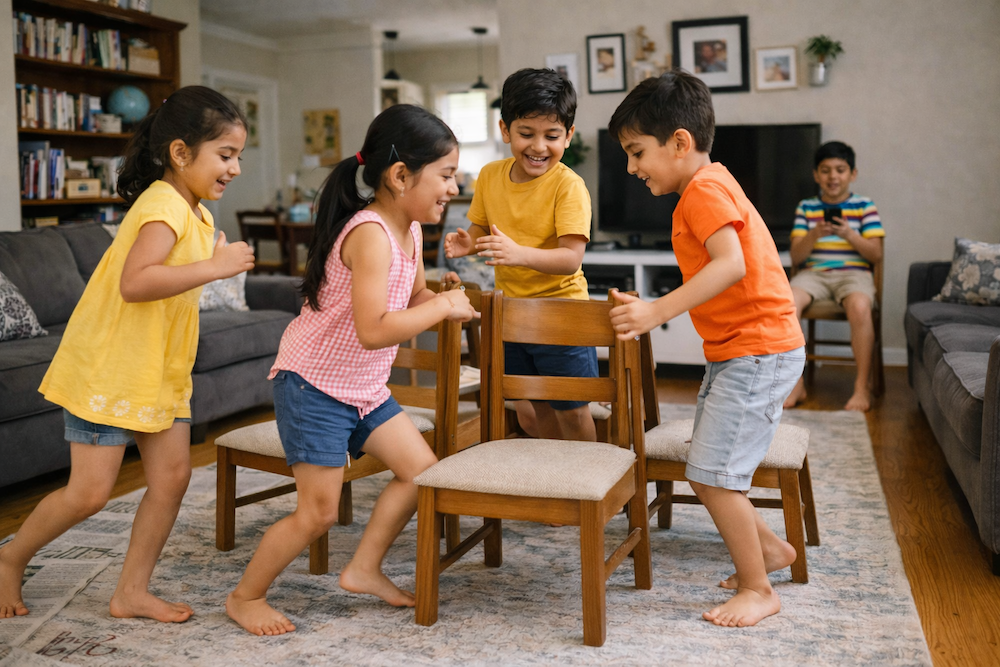
Arrange chairs in a row with one fewer than the number of players, play music, and when it stops, everyone scrambles to find a seat. For preschoolers, keep elimination gentle — the child who misses a seat becomes the music controller, keeping them involved and excited rather than benched. At this age, the value is the alertness, movement, and social energy of playing together, not the competition.
Musical Chairs is ideal for playdates or when cousins are visiting during Diwali or summer holidays. It scales easily — two children or eight, it works equally well. For the music, let children take turns choosing a favourite song — this added ownership makes the game feel more theirs and reduces disputes about whose turn it is.
Musical chairs needs at least two players, so it’s most useful on days when a cousin, neighbour’s child, or a friend is visiting. It’s not a solo independent-play option, but it’s an excellent structured activity to set up when you need children to be happily occupied together while you finish a task nearby.
14. Hot Potato — With a Twist
⭐ Best for: Ages 3–6 | Skills: Reflexes, self-expression, social confidence
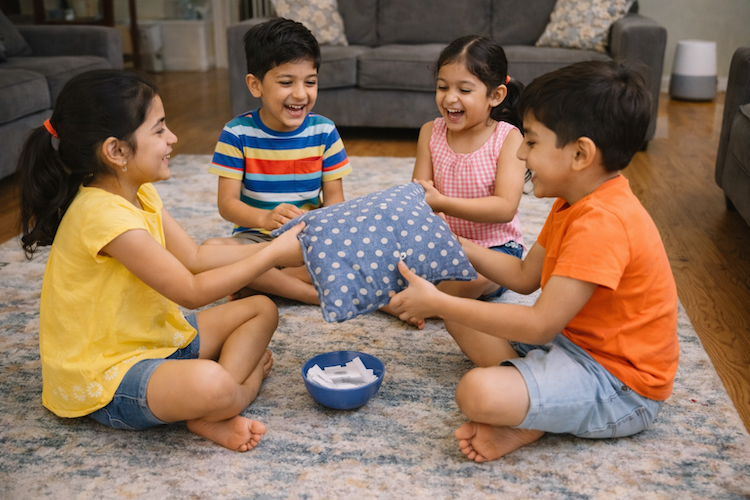
Pass a soft cushion around a circle while music plays. When the music stops, whoever holds it must answer a silly question (‘What would you eat for breakfast if you were a dinosaur?’) or perform a quick action (hop three times, do a funny face). This version removes the anxiety of elimination and replaces it with the joy of performance — something preschoolers love. Keep questions light, funny, and imaginative.
Write the action prompts or silly questions on small chits of paper before the game — fold them and keep them in a small bowl. When the music stops, the child holding the cushion draws a chit and reads it (or has an adult read it). Preparing the chits once means you can play the game repeatedly without having to think of new prompts on the spot. A great activity to set up once and reuse across several days.
With a grandparent or helper present, this game runs itself entirely without parent involvement. The chit bowl provides the structure, the music provides the signal, and the adults in the room need only manage the music player. Ideal for a day when you need an extended stretch of adult-free engagement for a small group of children.
15. Indoor Yoga Adventures
⭐ Best for: Ages 3–6 | Skills: Flexibility, focus, emotional regulation

Turn a yoga session into a story — ‘Today we’re going on a jungle safari. Let’s start as tall trees swaying in the wind, then crouch into tiny seeds, then stretch wide like a crocodile.’ Simple poses woven into a narrative are far more engaging for preschoolers than formal instruction. This is also one of the most effective ways to transition a high-energy child into a calmer state — ideal before nap time or before bed.
Several Indian apps and YouTube channels offer preschooler yoga in Hindi and English — search for ‘kids yoga India’ or ‘yoga for children in Hindi’ for age-appropriate guided sessions your child can follow independently with a tablet propped up. On days when you need a quiet, supervised-but-hands-off activity, a 15-minute guided yoga video (yes, this one warrants the screen time) with intentional use is a meaningful alternative to passive watching.
Indoor yoga is one of the most WFH-compatible activities in this list — it’s quiet, contained to a mat, and calming rather than stimulating. Perfect for the last hour of your workday when you need your child settled and you need focus. Set up the mat, play a gentle yoga story video or narrate a simple sequence, and this can give you a reliable 20-minute window.
16. Hot or Cold
⭐ Best for: Ages 3–5 | Skills: Listening, spatial reasoning, vocabulary
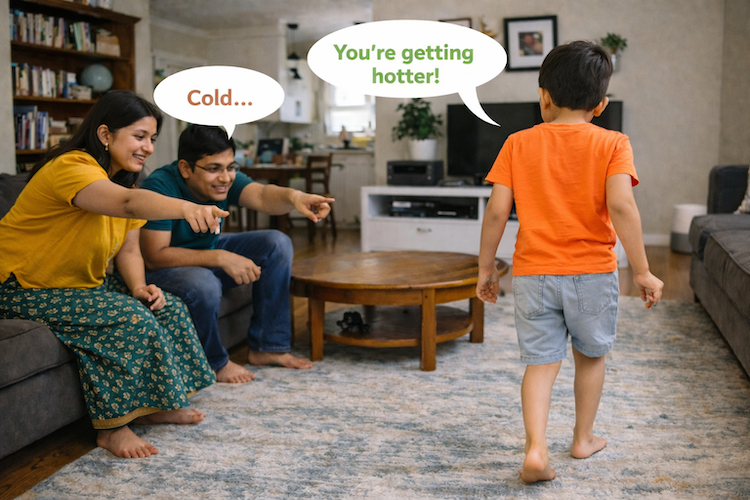
Hide a small object somewhere in the room. Guide your child to it using only ‘hot’ (getting closer) or ‘cold’ (moving away). Add gradations — ‘warm,’ ‘freezing,’ ‘boiling’ — to build vocabulary naturally. This game develops spatial reasoning and the ability to interpret verbal cues without visual guidance. It’s one of the simplest and most intimate one-on-one activities between a parent or grandparent and a young child.
The object can be anything from a favourite toy to a small snack as the ‘treasure.’ During festival seasons, hide a small mithai box or a Diwali chocolate and the excitement level doubles instantly. For grandparents who aren’t mobile, they can play this entirely from a chair — guiding with just their voice while the child does all the moving.
This is the rare activity that works during a call if you need to quietly engage a younger child (2–3 years) while managing something else. Hide the object before your call, whisper ‘find the hidden toy’ and let the game run. The child explores independently — you only need to occasionally mouth ‘warmer’ or ‘colder’ as they search.
17. Movement Memory
⭐ Best for: Ages 4–6 | Skills: Working memory, concentration, physical coordination
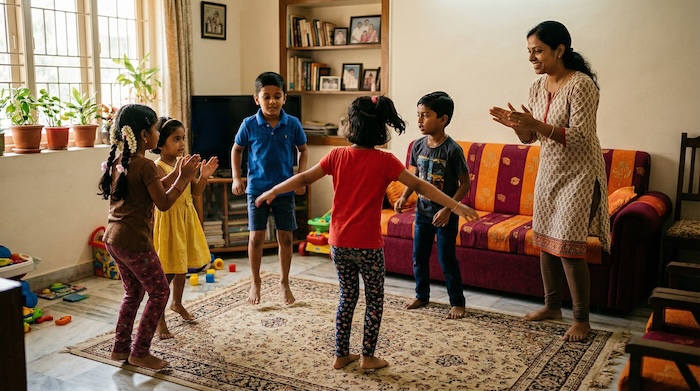
Build a sequence of movements together — jump, clap, spin, sit down — and have your child repeat the full sequence. Each round, add one new movement. How long a chain can they remember and perform? This game directly builds working memory, which is one of the strongest predictors of academic readiness in preschoolers. It’s also endlessly adaptable — use animal sounds, colours, or simple dance moves to vary it.
This activity connects naturally to the kind of structured, sequential learning that Indian preschool curricula tend to emphasise. Without feeling like schoolwork, movement memory builds the same cognitive skills — sequencing, recall, attention — that underpin early reading and maths. A small notebook where you and your child record ‘today’s sequence’ adds a lovely ritual element and gives the activity continuity across days.
Once a child understands the format (usually after one or two demonstrations), Movement Memory can be played solo — they try to remember and repeat the previous day’s sequence on their own. Leave a drawing of the sequence on a piece of paper as a visual reminder and let them practise independently while you work.
18. Red Light, Green Light
⭐ Best for: Ages 3–6 | Skills: Self-control, listening, physical activity
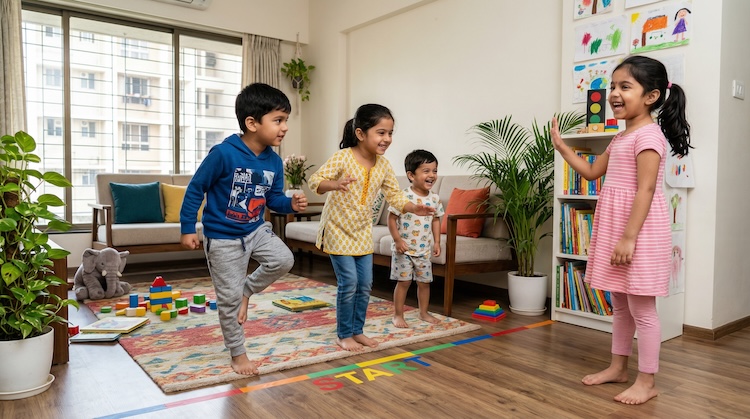
One child plays the traffic light, calling out ‘green light’ to move and ‘red light’ to stop. Anyone caught moving on red goes back to the start. For preschoolers, the game is less about winning and more about the delicious tension of wanting to move but having to stop — a fantastic self-regulation exercise wrapped in physical play. Rotate the traffic light role so everyone gets a turn being in charge.
Red Light, Green Light is particularly enjoyable for Indian children who are already familiar with the concept of traffic lights from daily life in metro cities — it connects a real-world experience to play in a way that feels meaningful. For older preschoolers (5–6 years), add ‘yellow light’ (slow motion walking) to increase complexity and make the game last longer.
This works well in an apartment hallway or a cleared living room. If you have a helper at home, they can manage the traffic light role entirely — the game needs a caller and players, and doesn’t require a parent. Set it up, explain the rules, and it runs without you for 15–20 minutes easily.
19. Silent Beanbag Pass
⭐ Best for: Ages 4–6 | Skills: Mindfulness, movement control, social awareness
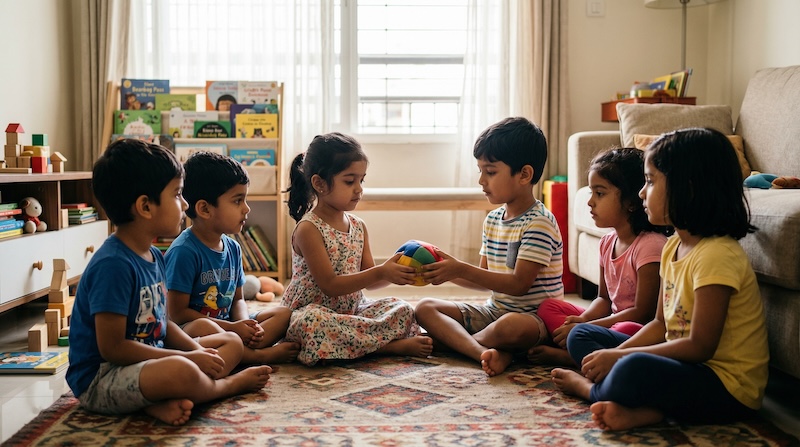
Sit in a circle and pass a beanbag or soft toy around without making any sound. If anyone speaks, giggles too loudly, or drops it, the group starts over together. The collective challenge of staying silent creates a surprisingly focused, calm atmosphere. Children take it seriously and find genuine satisfaction when they succeed together — it’s one of the best wind-down activities after an energetic stretch of play.
If you don’t have a beanbag, a small cloth potli filled with lentils or rice works perfectly — easy to make at home in two minutes using any old cotton cloth. This improvised version has a satisfying weight and texture that children enjoy. The activity is quiet enough to play in a bedroom while a parent takes a call in the adjacent room — it’s one of the calmest group activities in this list.
Silent Beanbag Pass is ideal for the transition between active play and quiet time — particularly useful on WFH days when you need children to shift gears from high-energy to settled. Run it for 5–10 minutes before a meal, a nap, or bedtime and notice how effectively it calms the room.
20. Twister
⭐ Best for: Ages 4–6 | Skills: Balance, coordination, flexibility, direction-following
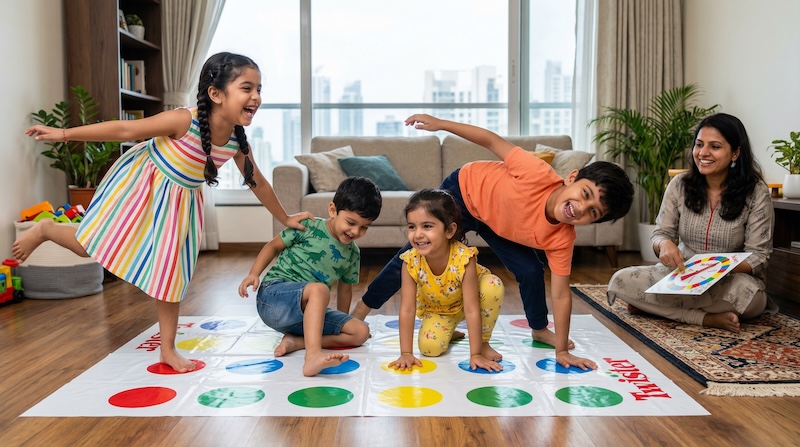
The classic colour-matching game that challenges children to stretch hands and feet to different coloured spots without falling. For preschoolers, simplify the rules if needed — just match the colour called, without worrying about left or right. Twister develops left-right awareness and body coordination, both foundational for early writing and physical education. The laughter it generates is genuinely therapeutic for the whole family.
Twister mats are available at toy stores and online across India (Hamleys, Flipkart, Amazon India) at accessible price points. Alternatively, make a DIY version using large circles of coloured chart paper taped to the floor — red, blue, yellow, green is all you need. The homemade version works just as well and can be stored flat between sessions. A wonderful option for a rainy weekend afternoon when the whole family is home.
Twister needs an adult or older child to call the colours and spin the wheel — it’s not a solo activity. But it’s one of the best ‘you barely need to move’ activities for a tired parent at the end of the day. Sit on the sofa, spin the dial or call colours randomly, and watch your child stretch and tumble for a solid 20 minutes while you stay right where you are.
|
🌧️
Monsoon Day Picks Indoor Obstacle Course — burns energy fast Freeze Dance — high energy with a calming payoff Indoor Camping — cosy monsoon evenings with grandparents Balloon Volleyball — apartment-friendly Scavenger Hunt — 30–45 min of independent play |
☀️
Summer Holiday Picks Group Art / Collaborative Mural — grows across the whole week Giant Floor Game Board — set up once, reuse every day Movement Memory — keeps minds sharp on holiday Tag Team Puzzles — builds over multiple sittings Treasure Hunt — theme it around summer fun |
Why Indoor Play Matters for Preschoolers?
For urban Indian families today, indoor play is not a backup option — it’s an essential part of a preschooler’s daily life. Between monsoon months, summer heat, apartment living, and the reality of parents working from home, children spend a significant portion of their early years playing indoors. What they do with that time matters enormously.
Cognitive Development
Activities like puzzles, memory games, scavenger hunts, and movement memory directly build concentration, problem-solving, and early numeracy and literacy skills. Play is how preschoolers make sense of abstract concepts — counting, colours, sequencing — in a way that feels natural rather than instructional. These are the same skills that determine how smoothly a child transitions into formal schooling.
Social and Emotional Development
Group games teach children to take turns, manage frustration, celebrate others, and collaborate. For children in nuclear families or single-child households — which is increasingly common in Indian metros — structured indoor play with parents, grandparents, or visiting cousins provides vital practice in social interaction that outdoor peer play would otherwise offer.
Physical Development
Indoor games like hopscotch, obstacle courses, balloon volleyball, and freeze dance ensure children stay physically active even when outdoor play isn’t possible. Gross motor development during the preschool years directly supports handwriting, physical confidence, and participation in sports later in school.
Screen-Free Time — and Why It Matters
For dual-income, urban Indian families where both parents are working and screens are the most convenient babysitter, structured indoor play provides a meaningful, engaging alternative. The goal isn’t to make parents feel guilty about screen time — it’s to make the non-screen option genuinely easy and accessible. Every activity in this list is designed to be low-setup and high-engagement, so reaching for it feels as easy as reaching for the tablet.
How to Encourage Indoor Play at Home
Create a dedicated play space. Even in a 2BHK apartment, designate a corner — a mat, a low shelf with accessible toys and art supplies — that signals to your child that this is their space. Child-proofing this area means you don’t need to hover constantly.
Let them lead sometimes. Not every indoor activity needs to be structured. Give your preschooler unstructured time with open-ended materials — blocks, drawing supplies, cushions — and watch what they create. Free play is as developmentally valuable as structured games.
Rotate activities every few days. The same game repeated daily loses its novelty quickly. Keep a bank of 6–8 indoor activities and cycle through them so each one feels fresh when it returns.
Join in when you can — even briefly. Children play longer and more enthusiastically when a parent participates. Even 10 minutes of genuine, present participation before you return to work makes a significant difference to how long they continue independently.
Tie play to learning naturally. Count jumps during hopscotch. Name colours during the mural. Ask ‘what comes next?’ during movement memory. These micro-moments of learning embedded in play are incredibly powerful for preschool-age children.
Praise the process, not just the outcome. When your child cooperates, shares, tries again after failing, or helps a sibling — acknowledge that specifically. ‘I loved how patient you were waiting for your turn’ builds a growth mindset far more effectively than simply praising the result.
KLAY Preschools & Daycare
Build your child’s future,
one playful activity at a time.
Our carefully designed indoor and outdoor activities support 360° development — every single day.


With an MSc in Biotechnology and nearly five years in content writing and editing, Priyanka blends analytical thinking with creativity to craft compelling narratives. As a mom to a curious five-year-old boy, she finds inspiration in everyday moments, turning ideas into stories that inform and connect.
Trending blogs
-
 For preschoolers, yoga isn’t about perfection but about giggles and...
 -
 Parenting is a journey filled with the brightest moments and...
 -
 Finding the perfect balance between professional commitments and parenting is...
 -
 Managing work commitments while ensuring your child receives quality care...
 -
 Winter’s In The Air. Make a Khichdi Of It! With...
Trending blogs
-
For preschoolers, yoga isn’t about perfection but about giggles and...
-
Parenting is a journey filled with the brightest moments and...
-
Finding the perfect balance between professional commitments and parenting is...
-
Managing work commitments while ensuring your child receives quality care...
-
Winter’s In The Air. Make a Khichdi Of It! With...






Subscribe to our newsletter
[contact-form-7 id="12706" title="Newsletter Form for post page"]Our Related Blogs
Yoga Benefits, Activities, and Poses for Preschoolers
For preschoolers, yoga isn’t about perfection but about giggles and benefits. So, are you curious how a simple stretch can support a child’s focus, flexibility, and emotional well-being? Let’s roll...
Year-End Reflection and Goal Setting for Children
Parenting is a journey filled with the brightest moments and valuable lessons, both for us and our children. As the year draws to a close, it’s the perfect time to...
Work-Life Balance Solutions for Parents in Emerald Hills Rd, Sector 65, Gurugram: The KLAY Daycare Advantage
Finding the perfect balance between professional commitments and parenting is a challenge for many working families in Gurugram. Parents in Emerald Hills Rd, Sector 65, especially, look for childcare solutions...