



 76767 08888

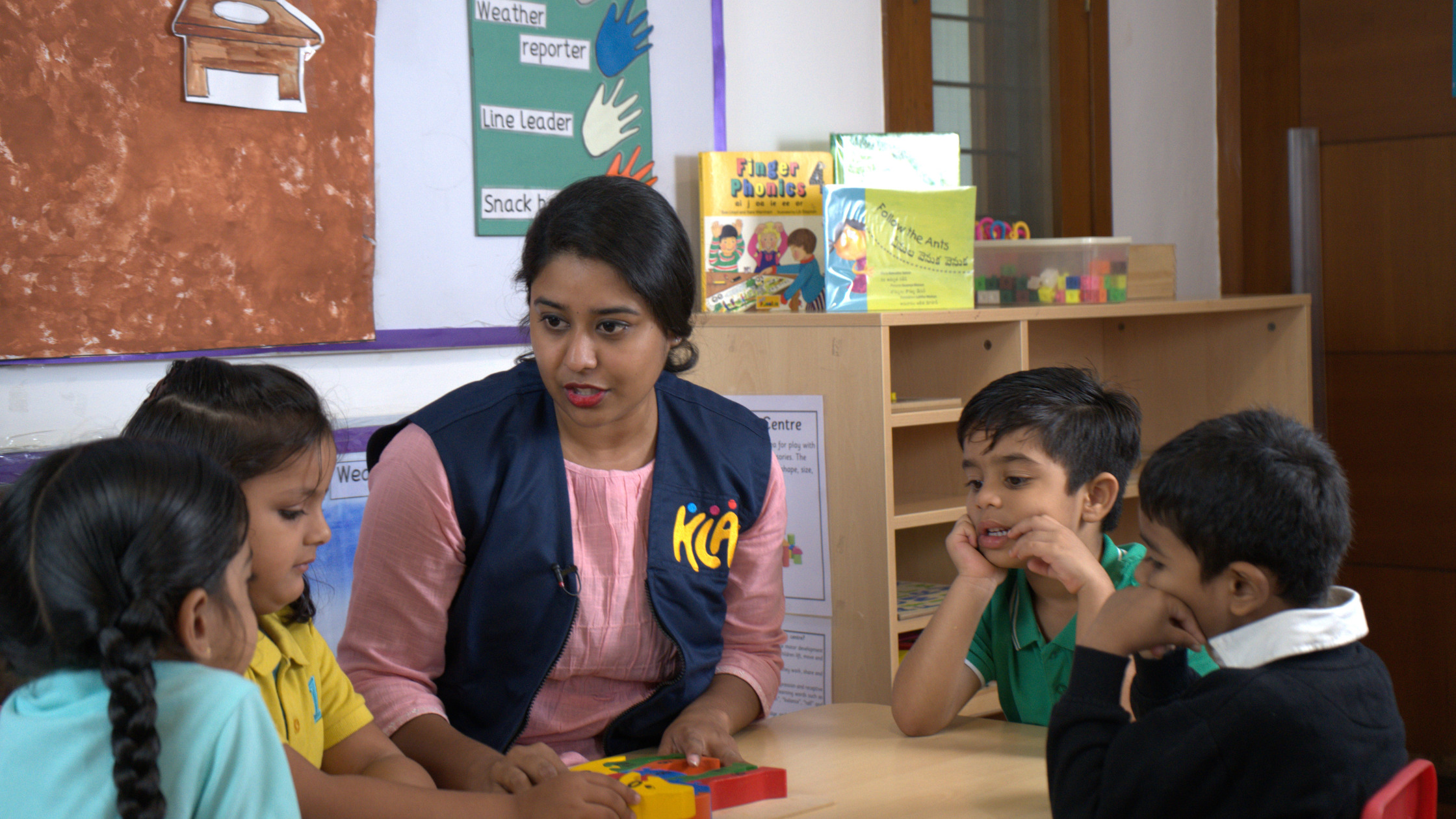


I once watched a child in a cafe repeatedly throw his toy on the floor. It looked like a tantrum at first, but when I looked again, I noticed there was no frustration, just curiosity in his face. He was completely focused on trying to understand what would happen every time the toy fell.
Children constantly try to figure out the world by trying things out in their own way. This blog on inquiry-based learning for preschoolers encourages them to inquire, explore, test, and discover through curiosity.
So, what is inquiry-based learning?
Inquiry-based learning is a way of learning where children take the lead instead of being told exactly what to do. Children learn by asking questions, experimenting, and exploring ideas through conversations, hands-on activities, and play. Instead of giving ready-made answers to children, it helps them to ask questions and discover through learning experiences.
Inquiry-based vs. traditional learning
In traditional learning, an educator or teacher guides the lesson, while the children listen, follow instructions, memorise, and repeat them. Traditional teaching focuses more on committing lessons to memory and correct answers.
What is an inquiry-based learning approach?
In this approach, the children are the centre of the learning process. This approach focuses on the learning process to encourage natural questioning, logical experiments, deep thinking, and developing cognitive skills.
For preschoolers, inquiry-based learning is more meaningful and interesting through everyday experiences.
Types of inquiry-based learning
There are different types of inquiry-based learning, where each supports different developmental stages and learning goals:
1. Structured inquiry
The educator provides the question and method, allowing children to explore and reach the answers themselves.
2. Confirmation inquiry
The educator provides the question and the solution while the children explore to confirm the answer.
3. Guided inquiry
The educator provides only the questions and guides children while they explore methods to find solutions.
4. Open inquiry
Children lead the learning process by creating their own questions, finding methods for the correct answer with minimal help.
Key principles of inquiry-based learning
1) Question and plan/questioning
Children ask questions freely based on their interests. Educators help them to explore and plan to reach the answers. This principle encourages children to take responsibility for learning.
2) Research and explore together/exploring
Children learn by exploring, playing, observing, discussing with others, and experimenting with their surroundings. This encourages them to participate in hands-on learning.
3) Present what they’ve learned and develop understanding/discovering
Children share their discoveries through drawing, telling stories, and discussing with others. Their presentation of discoveries helps them to further understand what they have learned and build confidence.
4) Reflect on the learning process/reflecting
Children think carefully about how they learned rather than what they learned. This reflection helps them to support problem-solving and critical-thinking skills.
5) Document learning
Educators create a record of every child’s questions, ideas, notes, and doodles through documents and photos. This makes learning visible and helpful for parents to understand their progress.
Is inquiry-based instruction right for preschool classrooms?
According to experts, inquiry-based instruction is highly effective for preschoolers when implemented thoughtfully. Preschoolers gain knowledge mostly through playing, exploring, and socially interacting with friends, family members, or strangers.
Although in inquiry-based learning, preschoolers lead the lessons, the educators play an equally important role. Educators observe the children’s interests and ideas, ask open-ended questions, provide resources for finding solutions, and gently guide them to lead their learning journey.
Benefits of Inquiry-Based Learning for Preschoolers
Inquiry-based learning helps preschoolers learn naturally and meaningfully. Let us see the answer to why inquiry-based learning is important:
1. Strengthens the curriculum
Inquiry-based learning makes children active learners by combining topics like literacy, numeracy, and science naturally into daily activities.
2. Makes learning more rewarding
Inquiry-based learning helps children develop their curiosity and motivation. When children discover answers for themselves, learning becomes more exciting.
3. Builds independence
When children lead in learning, they learn to think, trust their intuition, and develop their problem-solving and critical thinking abilities.
4. Aligns with STEM education
Inquiry drives children to experience early STEM concepts like Science, Technology, Engineering, and Mathematics.
5. Boosting preschoolers’ interests
Preschoolers are more interested in tasks if they can touch, feel, play around, and discuss with others, rather than memorising lessons.
6. Improves critical thinking skills
Inquiry-based learning encourages children to think deeply, reason, analyse, and make decisions to reach a solution. Learn more about how critical and cognitive skills help growing children.
7. Fosters creativity and motivation
Inquiry-based learning comes with open-ended questions, with preschools requiring brainstorming multiple possibilities. This motivates students to use their creativity for every problem.
8. Builds confidence
Confidence comes from doing and trying things on one’s own. Children heavily evaluate their own methods rather than relying on an educator’s validation. This helps to build self-confidence.
9. Helps in language and communication skills
When children explain their own ideas and processes, and ask questions, it not only helps their vocabulary but also their communication skills.
10. Encourages collaborative learning
As the educator acts like a guide, it drives preschoolers to depend on each other for sharing their discoveries, listening, understanding, and cooperating.
11. Provides a foundation for lifelong learning
Through this learning, children become independent problem-solvers and adaptable learners who will enjoy learning even beyond the classroom.
Inquiry-based learning examples
Let’s look at some inquiry-based learning works through simple examples:
1. Science experiments
Science experiments for preschoolers include sensory activities, watering plants, drawing a weather chart, using magnets, or melting ice. Know more science experiments for preschoolers.
2. Field trips
Field trips like visits to gardens, banks, post offices, supermarkets, farms, or museums turn theories into experiences. Check out this fun field trip experience.
3. Group work
Teamwork includes discussing ideas, solving problems, playing, and taking turns.
4. Projects
Long-term questions like, ‘How do plants grow?’, ‘Why is the sky blue?’, or ‘Why do birds fly?’
5. Classroom discussions
Motivating children to participate in listening to others’ thoughts and adding their ideas, observations, and opinions.
What parents should know when choosing a preschool?
Parents mostly look for a preschool that teaches more than memorising ABCs and 123s. They look for early education based on inquiry-based learning and life skills. Here are a few factors that a parent considers:
1. Beyond rote learning
A preschool setting that lets children willingly discover and explore lessons. Similarly, the KLAYEdge curriculum allows children to think, question, imagine, and explore. It encourages a smoother transition of a preschooler into the best schools in India.
2. Nurtures curiosity
An inquiry-based classroom invites children to ask questions and share ideas rather than being passive listeners.
3. Classroom facilitator
A good preschool has educators acting as guides rather than teachers. They gently nudge children’s ideas and critical and independent thinking.
4. Hands-on learning
Preschools with a strong curriculum like KLAYEdge involve play-based discoveries, science experiments, and group discussion, which improve confidence and cognitive skills.
5. Life-ready skills
A strong curriculum includes not just literacy and numeracy but also social, emotional, and practical skills. KLAY preschools and daycare make a child school-ready and life-ready.
Look here for a more helpful guide. Check out this guide for detailed information.
Conclusion
Inquiry-based learning for preschoolers revolves around their natural curiosity and transforming it into meaningful learning. KLAY preschools follow this approach, which ultimately helps children develop confidence, independence, and communication skills, all of which are important life skills. As KLAY preschoolers explore and discover, inquiry-based learning reassures the parents that their children are not just learning academics, but also how to navigate daily challenges.
FAQs
1. What is inquiry-based learning?
In simple terms, inquiry-based learning is a method in which children learn lessons by independently exploring, asking questions, and discovering answers, rather than rote learning.
2. How to use inquiry-based learning in the classroom?
In classrooms of KLAY, educators let children act as researchers. Educators guide their curiosity, provide resources while children explore ideas, and share their discoveries.
3. Will my child learn core academic skills through this approach?
Yes, inquiry-based learning naturally incorporates literacy, vocabulary, numeracy, problem-solving, and emotional regulation.
4. Why is it preferred over traditional learning?
Inquiry-based learning is preferred over traditional learning because children learn more than bookish knowledge and memorising lessons; they learn necessary life skills.
5. What are the guiding questions for inquiry-based learning?
An educator must ask these questions of the children to guide them –
What?
When?
Now what?
How?
Why?










Subscribe to our newsletter
[contact-form-7 id="12706" title="Newsletter Form for post page"]Our Related Blogs
Yoga Benefits, Activities, and Poses for Preschoolers
For preschoolers, yoga isn’t about perfection but about giggles and benefits. So, are you curious how a simple stretch can support a child’s focus, flexibility, and emotional well-being? Let’s roll...
Year-End Reflection and Goal Setting for Children
Parenting is a journey filled with the brightest moments and valuable lessons, both for us and our children. As the year draws to a close, it’s the perfect time to...
Work-Life Balance Solutions for Parents in Emerald Hills Rd, Sector 65, Gurugram: The KLAY Daycare Advantage
Finding the perfect balance between professional commitments and parenting is a challenge for many working families in Gurugram. Parents in Emerald Hills Rd, Sector 65, especially, look for childcare solutions...