



 76767 08888

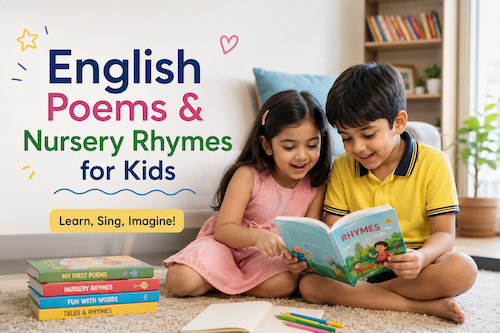


Key Takeaways
- Reciting nursery rhymes and poems helps children build strong language skills early.
- Nursery rhymes for kids improve their pronunciation, memory, and confidence. They also support their creativity and emotional expression.
- Rhymes and poems make early learning fun and engaging for young children.
- Regular practice can strengthen their listening as well as speaking skills.
Nursery rhymes for kids and simple poems are often a child’s first introduction to language. These short, rhythmic lines are easy to remember and enjoyable to repeat. They not only help kids build their vocabulary, but also improve pronunciation and develop speaking confidence.
Why Are Nursery Rhymes Important for Children?
Poems and rhymes are not only about memorising lines. They are an important part of a child’s overall language development.
- Teaches New Words Naturally: Preschool rhymes and easy poems for kids introduce them to new vocabulary in a fun way. The rhythmic repetition of words helps them remember words and understand sentence patterns better.
- Improves Pronunciation & Phonics: Listening to rhymes and repeating them helps children understand sounds clearly. This is especially useful when English is not their first language.
- Strengthens Memory Skills: Remembering nursery rhymes improves memory through repetition and recall. Children learn to remember sequences without feeling pressured.
- Builds Speaking Confidence: Children are more likely to feel confident when they recite poems in front of their peers or their parents. They learn how to express themselves without fear.
- Encourages Imagination & Creativity: Rhymes introduce children to creative ideas, characters, and scenarios. It helps them think beyond everyday experiences.
- Supports Emotional Expression: Children learn the importance of expressing emotions through word play, rhymes, music, and actions.
- Makes Learning Enjoyable: Learning through rhythm, music, and actions makes poems one of the most enjoyable ways to learn English.
20 Popular & Easy English Poems & Nursery Rhymes for Kids
This list of 20 fun and famous English poems and nursery rhymes is suitable for young kids.
-
The Wheels on the Bus
The wheels on the bus go round and round
Round and round
Round and round
The wheels on the bus go round and round
All through the town.The wipers on the bus go swish, swish, swish
Swish, swish, swish
Swish, swish, swish
The wipers on the bus go swish, swish, swish
All through the town.The people on the bus go up and down
Up and down
Up and down
The people on the bus go up and down
All through the town.The horn on the bus goes beep, beep, beep
Beep, beep, beep
Beep, beep, beep
The horn on the bus goes beep, beep, beep
All through the town.The babies on the bus go waa, waa, waa
Waa, waa, waa
Waa, waa, waa
The babies on the bus go waa, waa, waa
All through the town. -
Twinkle, Twinkle, Little Star
Twinkle, twinkle, little star,
How I wonder what you are!
Up above the world so high,
Like a diamond in the sky.When the blazing sun is gone,
When he nothing shines upon,
Then you show your little light,
Twinkle, twinkle, all the night.Then the traveller in the dark
Thanks you for your tiny spark,
How could he see where to go,
If you did not twinkle so?In the dark blue sky you keep,
Often through my curtains peep
For you never shut your eye,
Till the sun is in the sky.As your bright and tiny spark
Lights the traveller in the dark,
Though I know not what you are,
Twinkle, twinkle, little star. -
Rain, Rain, Go Away
Rain, rain, go away,
Come again another day.
Little [insert child’s name] wants to play,
Come again another day.Sun, sun, out you stay,
Warm us up for all the day.
Little [insert child’s name] wants to play,
Warm us up for all the day. -
I’m a Little Teapot
I’m a little teapot, short and stout,
Here is my handle, here is my spout.
When I get all steamed up, hear me shout,
Tip me over and pour me out. -
The Rainbow
Boats sail on the rivers,
And ships sail on the seas;
But clouds that sail across the sky
Are prettier far than these.There are bridges on the rivers,
As pretty as you please;
But the bow that bridges heaven,
And overtops the trees,
And builds a road from earth to sky,
Is prettier far than these. -
Little Miss Muffet
Little Miss Muffet
Sat on a tuffet,
Eating her curds and whey;
Along came a spider,
Who sat down beside her,
And frightened Miss Muffet away. -
Baa, Baa, Black Sheep
Baa, baa, black sheep
Have you any wool?
Yes sir, yes sir, three bags full.
One for the master,
And one for the dame,
And one for the little boy
Who lives down the lane. -
Humpty Dumpty
Humpty Dumpty sat on a wall,
Humpty Dumpty had a great fall;
All the king’s horses and all the king’s men
Couldn’t put Humpty together again. -
Old MacDonald Had a Farm
Old MacDonald had a farm ee-i-ee-i-o
And on that farm he had a duck ee-i-ee-i-o
With a quack, quack here and a quack, quack there
Here a quack, there a quack, everywhere a quack, quack
Old MacDonald had a farm ee-i-ee-i-o.Old MacDonald had a farm ee-i-ee-i-o
And on that farm he had a cow ee-i-ee-i-o
With a moo, moo here and a moo, moo there
Here a moo, there a moo, everywhere a moo, moo
Quack, quack here and a quack, quack there
Here a quack, there a quack, everywhere a quack, quack
Old MacDonald had a farm ee-i-ee-i-o.Old MacDonald had a farm ee-i-ee-i-o
And on that farm he had a dog ee-i-ee-i-o
With a woof, woof here and a woof, woof there
Here a woof, there a woof, everywhere a woof, woof
Moo, moo here and a moo, moo there.
Here a moo, there a moo, everywhere a moo, moo
Quack, quack here and a quack, quack there
Here a quack, there a quack, everywhere a quack, quack
Old MacDonald had a farm ee-i-ee-i-o.Old MacDonald had a farm ee-i-ee-i-o
And on that farm he had a pig ee-i-ee-i-o
With an oink, oink here and an oink, oink there
Here an oink, there an oink, everywhere an oink, oink
A woof, woof here and a woof, woof there
Here a woof, there a woof, everywhere a woof, woof
Moo, moo here and a moo, moo there
Here a moo, there a moo, everywhere a moo, moo
Quack, quack here and a quack, quack there
Here a quack, there a quack, everywhere a quack, quack
Old MacDonald had a farm ee-i-ee-i-o. -
Mary Had a Little Lamb
Mary had a little lamb, little lamb, little lamb.
Mary had a little lamb, its fleece was white as snow.
And everywhere that Mary went. Mary went. Mary went.
And everywhere that Mary went, the lamb was sure to go.It followed her to school one day, school one day, school one day.
It followed her to school one day, which was against the rule.
It made the children laugh and play, laugh and play, laugh and play.
It made the children laugh and play to see the lamb at school.And so the teacher sent it out, sent it out, sent it out.
And so the teacher sent it out, but still it lingered near.
It stood and waited round about, round about, round about.
It stood and waited round about, till Mary did appear.“Why does the lamb love Mary so, Mary so, Mary so?”
“Why does the lamb love Mary so?” the little children cry.
“Why, Mary loves the lamb, you know, lamb you know, lamb you know.”
“Why, Mary loves the lamb, you know.” The teacher did reply. -
Johny, Johny, Yes Papa
Johny, Johny, yes Papa?
Eating sugar? No Papa.
Telling lies? No Papa.
Open your mouth, ha ha ha! -
Bits of Paper
Bits of paper, bits of paper,
Lying on the floor, lying on the floor,
Make the place untidy, make the place untidy,
Pick them up, pick them up. -
Teddy Bear, Teddy Bear
Teddy bear, teddy bear, turn around,
Teddy bear, teddy bear, touch the ground,
Teddy bear, teddy bear, reach up high,
Teddy bear, teddy bear, touch the sky,
Teddy bear, teddy bear, bend down low,
Teddy bear, teddy bear, touch your toes,
Teddy bear, teddy bear, go to bed,
Teddy bear, teddy bear, rest your head,
Teddy bear, teddy bear, turn out the lights,
Teddy bear, teddy bear, say “good night”. -
Head, Shoulders, Knees and Toes
Head, shoulders, knees and toes,
Knees and toes.
Head, shoulders, knees and toes,
Knees and toes.
And eyes and ears and mouth and nose.
Head, shoulders, knees and toes,
Knees and toes. -
Jack and Jill
Jack and Jill went up the hill
To fetch a pail of water.
Jack fell down and broke his crown,
And Jill came tumbling after.(Some longer versions continue with:)
Up Jack got, and home did trot,
As fast as he could caper,
He went to bed to mend his head,
With vinegar and brown paper. -
If You’re Happy and You Know It
If you’re happy and you know it, clap your hands
If you’re happy and you know it, clap your hands
If you’re happy and you know it
And you really want to show it
If you’re happy and you know it, clap your hands.If you’re happy and you know it, stamp your feet
If you’re happy and you know it, stamp your feet
If you’re happy and you know it
And you really want to show it
If you’re happy and you know it, stamp your feet.If you’re happy and you know it, shout ‘Hurray!’
If you’re happy and you know it, shout ‘Hurray!’
If you’re happy and you know it
And you really want to show it
If you’re happy and you know it, shout ‘Hurray!’If you’re happy and you know it, do all three
If you’re happy and you know it, do all three
If you’re happy and you know it
And you really want to show it
If you’re happy and you know it, do all three. -
Five Little Monkeys
Five little monkeys jumping on the bed,
One fell down and bumped his head,
Mama called the doctor, and the doctor said,
No more monkeys jumping on the bed!Four little monkeys jumping on the bed,
One fell down and bumped his head,
Mama called the doctor, and the doctor said,
No more monkeys jumping on the bed!Three little monkeys jumping on the bed,
One fell down and bumped her head,
Mama called the doctor, and the doctor said,
No more monkeys jumping on the bed!Two little monkeys jumping on the bed,
One fell down and bumped his head,
Mama called the doctor, and the doctor said,
No more monkeys jumping on the bed!One little monkey jumping on the bed,
She fell down and bumped her head,
Mama called the doctor, and the doctor said,
Put those monkeys back to bed! -
Chubby Cheeks
Chubby cheeks, dimple chin
Rosy lips, teeth within
Curly hair, very fair
Eyes are blue – lovely too.
Teacher’s pet, is that you?
Yes, Yes, Yes! -
Hickory Dickory Dock
Hickory dickory dock, the mouse ran up the clock.
The clock struck one, the mouse ran down, hickory dickory dock.(Some longer versions continue with:)
Hickory dickory dock, the mouse ran up the clock.
The clock struck two, the mouse said “Boo!” Hickory dickory dock.Hickory dickory dock, the mouse ran up the clock.
The clock struck three, the mouse said “Whee!” Hickory dickory dock.Hickory dickory dock, the mouse ran up the clock.
The clock struck four, the mouse said “No more!” Hickory dickory dock. -
Row, Row, Row Your Boat
Row, row, row your boat
Gently down the stream
Merrily, merrily, merrily, merrily
Life is but a dream.Row, row, row your boat
Gently down the stream.
If you see a crocodile
Don’t forget to scream!
Aaaah!
How to Teach Rhymes to Preschoolers: Practical Tips for Parents & Teachers
-
Read Expressively
Poems and rhymes are meant to be heard and felt, not just memorised. Reading with the right expression helps children understand meaning and rhythm better.
- Read slowly so children can follow each word clearly.
- Use pauses at commas and full stops.
- Change your tone based on the mood of the rhyme.
- Emphasise rhyming words to highlight patterns.
-
Encourage Visual Learning
Children understand better when they can see and imagine what they are learning.
- Kids can draw simple objects from the rhyme they hear, like stars or mountains, to help them visualise.
- You can also give them rhyme books with illustrations to help them with their imagination.
-
Add Actions & Gestures While Reciting
Movement makes learning more fun and helps children remember lines easily. Action-based learning keeps them actively involved.
- Use simple hand movements or facial expressions.
- Encourage children to act out parts of the poem.
-
Connect Poems to Real-Life Experiences
Children learn better when they can relate poems to their daily life.
- Ask questions based on real-life situations.
- Link the poem to things they see around them.
- Discuss simple examples from their daily routine.
This helps children understand the message behind the rhyme and apply it in real life.
-
Break Poems into Small, Manageable Parts
Long poems can feel overwhelming for young learners. Breaking them into smaller parts makes learning easier and less stressful.
- Teach 2 to 3 lines at a time.
- Repeat lines daily for better recall.
- Revise previous lines before adding new ones.
FAQs
-
What are good English poems for kids?
Good English poems for kids are simple, rhythmic, and easy to understand, such as classic nursery rhymes and short poems. They focus on rhythm and spark imagination.
-
At what age should children start learning poems?
Children can start learning nursery rhymes and simple poems from the age of 2 to 3 years.
-
How do poems help kids learn English?
Poems help children learn English by making them listen, repeat, and recognise patterns in language. When children recite poems, they practise pronunciation, learn new words through repetition, and understand sentence flow naturally.
-
What is the most famous nursery rhyme?
“Twinkle, Twinkle, Little Star” is one of the most popular nursery rhymes.
-
At what age can babies start singing nursery rhymes?
Babies can start recognising and responding to rhymes from around 1.5 to 2 years.
-
How do nursery rhymes help children’s development?
Nursery rhymes help children develop by using rhythm and repetition, which makes it easier for them to remember words and recognise sound patterns. When children sing and repeat rhymes, they naturally improve listening, coordination, and early language skills.
-
How often should children practise poems?
Following short daily practice sessions is better than long and irregular ones. Encourage children to practise daily for at least 10 to 15 minutes for better retention.
-
Can poems improve speaking skills?
Yes, reciting poems improves their pronunciation, fluency, and confidence.










Subscribe to our newsletter
[contact-form-7 id="12706" title="Newsletter Form for post page"]Our Related Blogs
Yoga Benefits, Activities, and Poses for Preschoolers
For preschoolers, yoga isn’t about perfection but about giggles and benefits. So, are you curious how a simple stretch can support a child’s focus, flexibility, and emotional well-being? Let’s roll...
Year-End Reflection and Goal Setting for Children
Parenting is a journey filled with the brightest moments and valuable lessons, both for us and our children. As the year draws to a close, it’s the perfect time to...
Work-Life Balance Solutions for Parents in Emerald Hills Rd, Sector 65, Gurugram: The KLAY Daycare Advantage
Finding the perfect balance between professional commitments and parenting is a challenge for many working families in Gurugram. Parents in Emerald Hills Rd, Sector 65, especially, look for childcare solutions...